
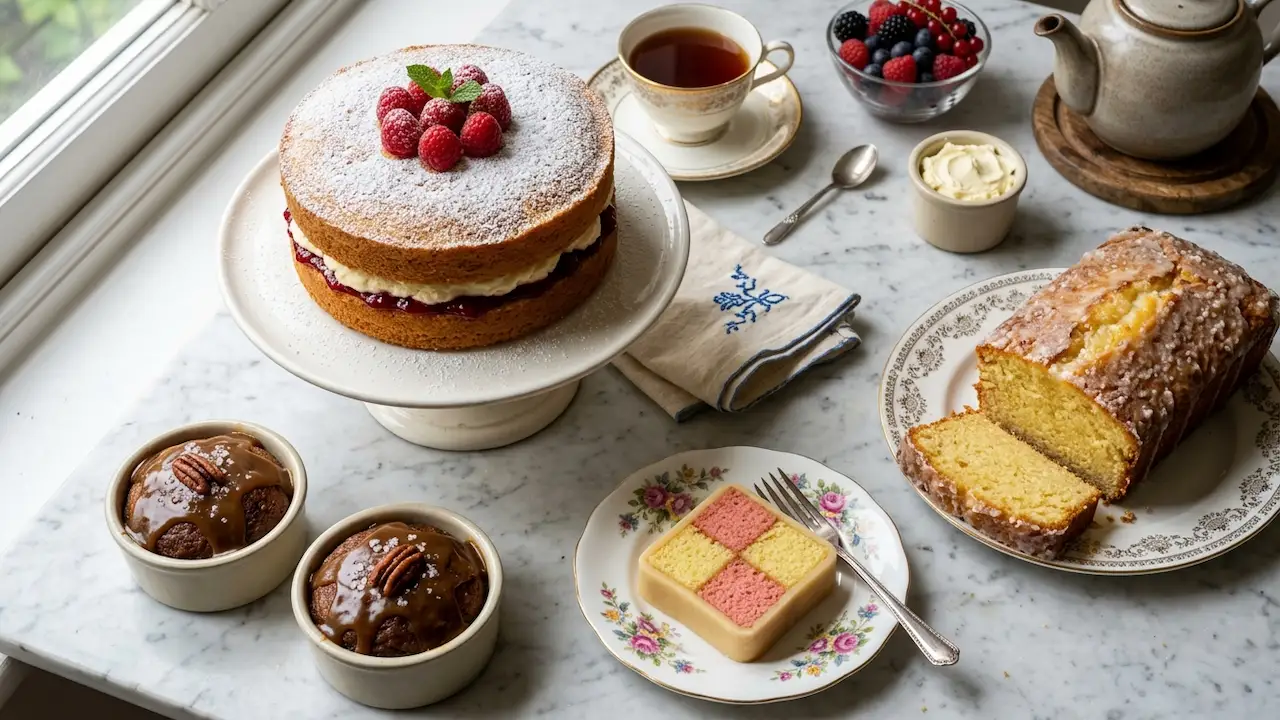
Famous London cakes are not just desserts. They are edible history, each one tied to a specific moment in British culture, a royal occasion, a pub tradition, or an afternoon ritual that has been repeated in kitchens across England for generations. The city that gave the world the Victoria Sponge, the Battenberg, and the Lemon Drizzle has a baking identity that is entirely its own: less sweet than American counterparts, deeply butter-forward, fruit-filled rather than frosting-heavy, and rooted in the kind of simple technique that produces something genuinely elegant without requiring pastry school credentials.
This guide covers the five most iconic famous London cakes, the history behind each one, a practical at-home recipe approach for every single one, and the essential British baking techniques that separate a proper sponge from a mediocre one.
To see how these traditional British classics compare to what is trending in global baking right now, see our guide on what cakes are trending.
Table of Contents
The History Behind London’s Most Iconic Bakes
Baking has always been inseparable from ceremony and celebration in British culture, and the cakes that London is most famous for all carry stories that reach back centuries.
The Victoria Sponge takes its name directly from Queen Victoria herself, who is said to have enjoyed a slice with her afternoon tea, a ritual she helped establish as a social institution across the British Empire. The cake named after her became the defining British teatime cake, the one by which all other sponges were measured.
The Battenberg cake was created in 1884 to celebrate the marriage of Princess Victoria, granddaughter of Queen Victoria, to Prince Louis of Battenberg. The four squares of the checkered pattern are said to represent the four Battenberg princes, though food historians debate the origin story. What is undisputed is that the cake became a fixture of British tea tables and remains one of the most visually recognizable famous London cakes in existence.
Eccles cakes, meanwhile, trace their commercial history to a shop in Eccles, Greater Manchester, opened in 1793, though their migration into London bakeries made them part of the capital’s pastry identity over the following two centuries.
Sticky toffee pudding is more recent: its modern form is generally attributed to Francis Coulson of the Sharrow Bay Country House Hotel in the 1970s, though the cake spread rapidly into London restaurants and pubs, where it became one of the most ordered British desserts of the late twentieth century.
Just as these historic British cakes carry deep cultural meaning tied to milestones and celebrations, our article on graduation cakes, the sweetest way to celebrate success, explores how baked goods continue to mark modern life milestones.
Top 5 famous London cakes You Can Bake at Home
1. Classic Victoria Sponge Cake
The Victoria Sponge is the most quintessentially British of all London’s famous cakes and the one that defines what a proper English teatime cake should be: two layers of light, buttery golden sponge sandwiched with a filling of strawberry jam and freshly whipped cream, dusted with a thin layer of icing sugar on top. No fondant. No elaborate frosting. No decoration beyond the dusting. The beauty of the Victoria sponge is that its simplicity is entirely intentional.
The recipe follows the equal-weight method: equal weights of butter, caster sugar, eggs, and self-raising flour are creamed together and then gently folded to preserve the air beaten into the butter and sugar during creaming. For a standard 2-layer 8-inch Victoria sponge, the typical quantities are 225g of each component, producing a batter that bakes in two sandwich tins at 180 degrees Celsius for approximately 20 to 25 minutes.
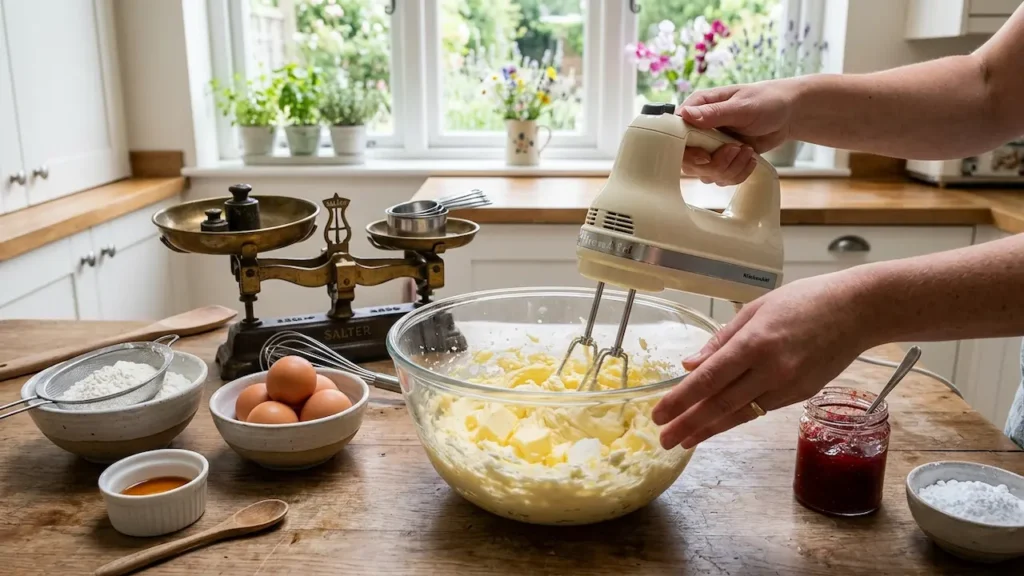
Key technique: the creaming stage, beating the butter and sugar together until the mixture is pale, almost white, and noticeably increased in volume, is what determines the lightness of the finished sponge. Rushing this step produces a denser, less airy crumb. Use butter at genuine room temperature (not softened in the microwave, which creates uneven softening) and cream for a minimum of 4 to 5 minutes with a hand or stand mixer.
The filling: genuine strawberry jam, preferably a high-fruit-content British brand rather than a pectin-heavy preserve, spread generously on the base layer, topped with freshly whipped cream that has been lightly sweetened with a small amount of icing sugar and vanilla. Sandwich the top layer on and dust immediately before serving.
If you love baking fruit-filled treats, our honey peach cream cheese cupcakes are a natural next bake: the same principle of simple batter elevated by quality fruit filling in a more individually portioned format.
2. Lemon Drizzle Cake
The Lemon Drizzle is arguably the most reliably popular cake in London coffee shops and home kitchens, and its appeal is easy to understand: it is intensely lemony, moist from the drizzle that soaks into the hot cake immediately after baking, and finished with a crunchy granulated sugar crust that contrasts beautifully with the tender interior crumb.
The base is a standard all-in-one sponge method: self-rising flour, caster sugar, softened butter, eggs, and a generous amount of finely grated lemon zest (from at least two large lemons) are combined until smooth. The batter is baked in a loaf tin rather than a sandwich tin, which produces the characteristic dense, rectangular shape of the classic lemon drizzle.
The drizzle itself is the defining step: immediately after removing the cake from the oven, while it is still hot and the crumb is still open and receptive, prick the surface all over with a skewer and pour a mixture of freshly squeezed lemon juice and caster sugar (approximately 4 tablespoons of lemon juice to 3 tablespoons of caster sugar) evenly over the surface. The sugar does not fully dissolve: the combination of the dissolving sugar and the undissolved crystals produces the crunchy, slightly opaque crust that is the visual signature of this famous London cake.
Important note: the lemon drizzle improves significantly with resting. Made the day before, the drizzle distributes more evenly through the crumb, and the lemon flavor deepens and mellows. It is genuinely one of the rare cakes that is better on day two.
If your sponges have ever sunk in the middle or collapsed on cooling, our guide on why did banana bread collapses covers the oven temperature, overmixing, and structural issues that affect most quick bread and sponge-style bakes.
3. Sticky Toffee Pudding
Sticky toffee pudding occupies a slightly different category from the other famous London cakes because it is technically a steamed or baked pudding rather than a traditional layer cake, but it appears on every British dessert menu and in every serious British baking collection, and its identity is inseparable from London pub and restaurant culture.
The base is a dark, moist date sponge: dried dates that have been soaked in boiling water with bicarbonate of soda (which softens them and neutralizes their tannins) are beaten into a relatively standard sponge batter. The baking soda and the dates together produce a very dark, slightly sticky crumb with a deep molasses-like flavor that is the foundation of the dish’s character.
The toffee sauce, made from butter, dark brown sugar, and double cream cooked together until thick and flowing, is poured over the warm pudding immediately before serving. The combination of the warm, dense date sponge absorbing the hot toffee sauce at the table is what makes this dessert so consistently popular: it is the kind of thing that produces genuine silence at the table while people eat.
Serving suggestion: Sticky toffee pudding must be served warm. It can be made in a large baking dish or in individual pudding basins (ramekins), which are more practical for dinner parties. Reheated in the microwave for 30 to 45 seconds with the sauce poured fresh from the stovetop, leftovers are almost as good as the original.
For more rich and genuinely indulgent homemade desserts in a similar spirit, our gourmet chocolate mousse banana delivers a deeply satisfying, composed dessert that requires minimal baking skills.
4. Battenberg Cake
The Battenberg is the most technically demanding of the famous London cakes in this guide but also the most visually rewarding: when sliced, the alternating pink and yellow squares wrapped in a layer of marzipan reveal a perfect checked pattern that looks almost impossibly precise for a home-baked cake.
The method requires baking two separate sponges (one plain, one colored pink with a small amount of red or pink food coloring), cutting each into long strips of equal width, and assembling them into the characteristic 2×2 checked pattern using warmed apricot jam as the adhesive between the strips. The assembled cake is then wrapped completely in a rolled layer of marzipan, pressed to adhere on all sides, and the join sealed at the base.
The sponge itself is a standard Victoria sponge-ratio batter, divided equally between two portions: one left plain and one tinted pink. Both are baked simultaneously in a divided tin (a Battenberg tin, which has a central divider) or in two separate small loaf tins and then cut to the same dimensions. Precision in cutting the strips to equal width is the key to a clean checked pattern in the final slice.
Marzipan note: Use a good-quality, relatively firm marzipan (not the soft confection in a tube) for the outer layer. It should be rolled thin enough to wrap the cake neatly without being so thin it tears, approximately 3 to 4mm.
If you enjoy the methodical, structured approach that Battenberg requires, our sourdough cinnamon bread is another baking project that rewards patience and precision with a genuinely beautiful layered result.
5. Eccles Cake
The Eccles cake is the smallest and most portable of the famous London cakes in this guide: an individual hand pie of flaky puff pastry filled with a sticky, intensely spiced mixture of dried currants, candied peel, butter, brown sugar, and warming spices, topped with a sprinkle of caster sugar that caramelizes in the oven to a thin, sweet crust.
For a home version, store-bought all-butter puff pastry produces excellent results and is far more practical than making puff pastry from scratch. The filling is made by warming butter with brown sugar, mixed spice, and a pinch of nutmeg, then combining with currants and finely chopped candied orange peel. This filling is placed in the center of a circle of rolled pastry, the edges are gathered and sealed over the top, the parcel is turned so the smooth side faces up, and three diagonal cuts are made across the surface to allow steam to escape.
The finished cakes are brushed with egg white and dusted with caster sugar before baking at a high temperature (approximately 220°C) for 15 to 20 minutes until deeply golden and caramelized.
Serving note: Eccles cakes are traditionally served warm, either alone or with a slice of Lancashire cheese, the classic British pairing of sweet and savory pastry with aged cheese that sounds unusual and tastes genuinely excellent.
For more technically interesting pastry and dessert projects, see our “What Is a Knafeh Chocolate Bar?” guide and our chewy Dubai chocolate cookie for two other recipes that reward a little extra technique.
PrintThe Ultimate Guide to Famous London Cakes (How to Bake Them at Home)
- Yield: 8 servings 1x
- Category: Dessert
- Cuisine: British
Ingredients
- 225g unsalted butter, softened
- 225g caster sugar
- 225g self-raising flour
- 4 large eggs
- Strawberry jam
- 300ml heavy whipping cream
- Icing sugar
- 2 large lemons (zest and juice)
- 4 tbsp lemon juice
- 3 tbsp caster sugar (for drizzle)
- 200g pitted dates
- 1 tsp baking soda
- 200ml double cream
- 150g dark brown sugar
- Pink food coloring
- Apricot jam
- 500g marzipan
- 1 sheet all-butter puff pastry
- 200g currants
- Candied orange peel
- Mixed spice
- Ground nutmeg
- 1 egg white
Instructions
- Preheat the oven to 350°F (180°C) and prepare the appropriate baking tins.
- Cream the butter and caster sugar until pale and fluffy.
- Add the eggs one at a time, mixing well after each addition.
- Gently fold in the self-raising flour until just combined.
- For Victoria Sponge, divide the batter between two round cake tins and bake for 20 to 25 minutes. Cool before filling with strawberry jam and whipped cream.
- For Lemon Drizzle Cake, bake the batter in a loaf pan, then pour freshly mixed lemon juice and caster sugar over the hot cake after piercing the surface.
- For Sticky Toffee Pudding, soak chopped dates with baking soda in boiling water, blend into the batter, bake, then serve warm with homemade toffee sauce.
- For Battenberg Cake, divide the batter into plain and pink portions, bake separately, cut into strips, assemble with apricot jam, and wrap with marzipan.
- For Eccles Cakes, fill circles of puff pastry with the currant mixture, seal, score the tops, brush with egg white, sprinkle with sugar, and bake at 425°F (220°C) until golden.
- Allow cakes to cool or rest as recommended before serving for the best flavor and texture.
Notes
Use room-temperature ingredients for light, airy British sponge cakes. Avoid overmixing once the flour is added, and use an oven thermometer for accurate baking temperatures. Lemon Drizzle Cake tastes even better the next day after the syrup fully absorbs.
Nutrition
- Serving Size: 1 serving
- Calories: 420
- Sugar: 29g
- Sodium: 210mg
- Fat: 22g
- Saturated Fat: 13g
- Unsaturated Fat: 8g
- Trans Fat: 0g
- Carbohydrates: 52g
- Fiber: 2g
- Protein: 6g
- Cholesterol: 95mg
Essential Baking Tips for British-Style Sponges
British sponge cakes, which form the foundation of four of the five famous London cakes in this guide, are built on a set of techniques that differ subtly but meaningfully from American cake-baking conventions.
The creaming method. British sponge recipes almost universally use the creaming method: butter and sugar are beaten together first, before any other ingredients are added, to create a light, aerated base that traps air during baking. This is what gives British sponges their characteristic delicate, tender crumb. The alternative (the all-in-one method, where all ingredients go in together) is faster but produces a slightly denser result.
Room-temperature ingredients. Cold butter cannot cream properly: it remains in hard lumps that never fully incorporate with the sugar, resulting in a dense, uneven crumb. Cold eggs can cause the creamed butter and sugar mixture to curdle, which similarly affects the final texture. Remove butter and eggs from the refrigerator a minimum of 30 minutes before beginning, longer if your kitchen is cool.
Gentle folding. Once the flour is added to the creamed base, the goal is to combine the ingredients while preserving as much of the air trapped during creaming as possible. Use a large metal spoon or a rubber spatula and fold in a figure-eight motion, cutting through the center of the batter and folding over. Stop the moment no streaks of flour are visible: overmixing at this stage develops gluten and makes the sponge tough.
Oven accuracy. British baking temperatures are precise because the sponges are delicate. An oven that runs hot will set the exterior before the center rises, causing the characteristic dome collapse. An oven that runs cool will produce a pale, under-set crumb that collapses on cooling. An inexpensive oven thermometer is one of the best investments for British-style baking.
For insights into how fermentation and batter resting improve texture in a related baking context, our guide on what I can do with old sourdough discard and our article on why sourdough pancakes are better both explain the chemistry of rested batters in accessible terms.
Frequently Asked Questions About famous London cakes
Pode Comer Gelatina no Jejum?
Depende do tipo de gelatina e do seu objetivo com o jejum. A gelatina tradicional com açúcar quebra o jejum imediatamente por elevar a insulina. A gelatina zero tem impacto calórico mínimo (7 a 10 kcal) e não compromete o emagrecimento de forma prática, mas os adoçantes artificiais podem gerar resposta cefálica da insulina e reduzir a autofagia em jejuns mais longos. A gelatina incolor sem sabor é pura proteína e tecnicamente interrompe o jejum metabólico completo, embora o impacto prático no emagrecimento seja pequeno.
Qual Alimento Não Quebra o Jejum Intermitente?
Os únicos itens comprovadamente seguros em qualquer protocolo de jejum intermitente são água mineral, água com gás sem sabor, café preto sem açúcar ou adoçante, e chás naturais preparados apenas com água e a planta sem nenhuma adição. Qualquer outro alimento, mesmo os de baixíssima caloria, pode ter algum impacto dependendo do objetivo do jejum, especialmente em protocolos voltados para autofagia.
Pode Quebrar Jejum com Colágeno?
O colágeno hidrolisado, assim como a gelatina incolor, é proteína pura e tecnicamente ativa a via metabólica mTOR, interrompendo a autofagia mesmo sem açúcar e com impacto calórico baixo. Para jejuns focados exclusivamente em emagrecimento, uma pequena quantidade de colágeno tem impacto prático negligenciável. Para jejuns focados em autofagia e renovação celular, o colágeno deve ser reservado para a janela de alimentação.
Tomar Gelatina em Jejum Emagrece?
A gelatina por si só não emagrece: o emagrecimento acontece pelo déficit calórico total ao longo do dia e pela manutenção do estado de lipólise durante o jejum. O que a gelatina incolor pode fazer, quando consumida dentro da janela de alimentação, é contribuir com proteína de baixa caloria que ajuda na saciedade e reduz o apetite nas refeições seguintes. Tomar gelatina com açúcar durante o jejum, ao contrário, interrompe a queima de gordura e prejudica os resultados do emagrecimento.
Quantas Calorias Tem a Gelatina Zero?
Uma porção padrão de gelatina zero industrializada contém entre 7 e 10 kcal, provenientes de traços de proteína e dos adoçantes artificiais utilizados. Para comparação, a gelatina tradicional com açúcar tem entre 80 e 100 kcal por porção e entre 17 e 20 gramas de açúcar.
A Gelatina Incolor Quebra o Jejum?
Sim, tecnicamente. Mesmo sem açúcar e com impacto calórico muito baixo, os aminoácidos da gelatina incolor ativam a via mTOR e sinalizam ao organismo a presença de nutrientes, o que reduz ou interrompe a autofagia. Para jejuns voltados ao emagrecimento, o impacto prático é mínimo. Para jejuns com foco em autofagia rigorosa, a gelatina incolor deve ficar para a janela de alimentação.
If you are planning a full afternoon tea spread and want to serve a complete experience with both food and drinks, pair your homemade famous London cakes with a warming gemada tradicional or a refreshing matcha affogato as your beverage options.
Related Reading
- Boston Cream Donut – A custard-filled pastry in a different but related tradition to British baking
- Dot Cake Recipe – A contemporary homemade cake format with its own devoted following
- Chocolate-Covered Pecans – A simple no-bake confection worth adding to any afternoon tea spread
Ready to Bake Famous London Cakes? 🇬✨
These iconic British treats are easier than you think! Save the pin for the visual guide, or dive into the full recipes below. Perfect for afternoon tea, special occasions, or satisfying that sweet tooth!
📌 Save to Pinterest💡 Why save? You’ll get a visual ingredient checklist + step-by-step photos!