
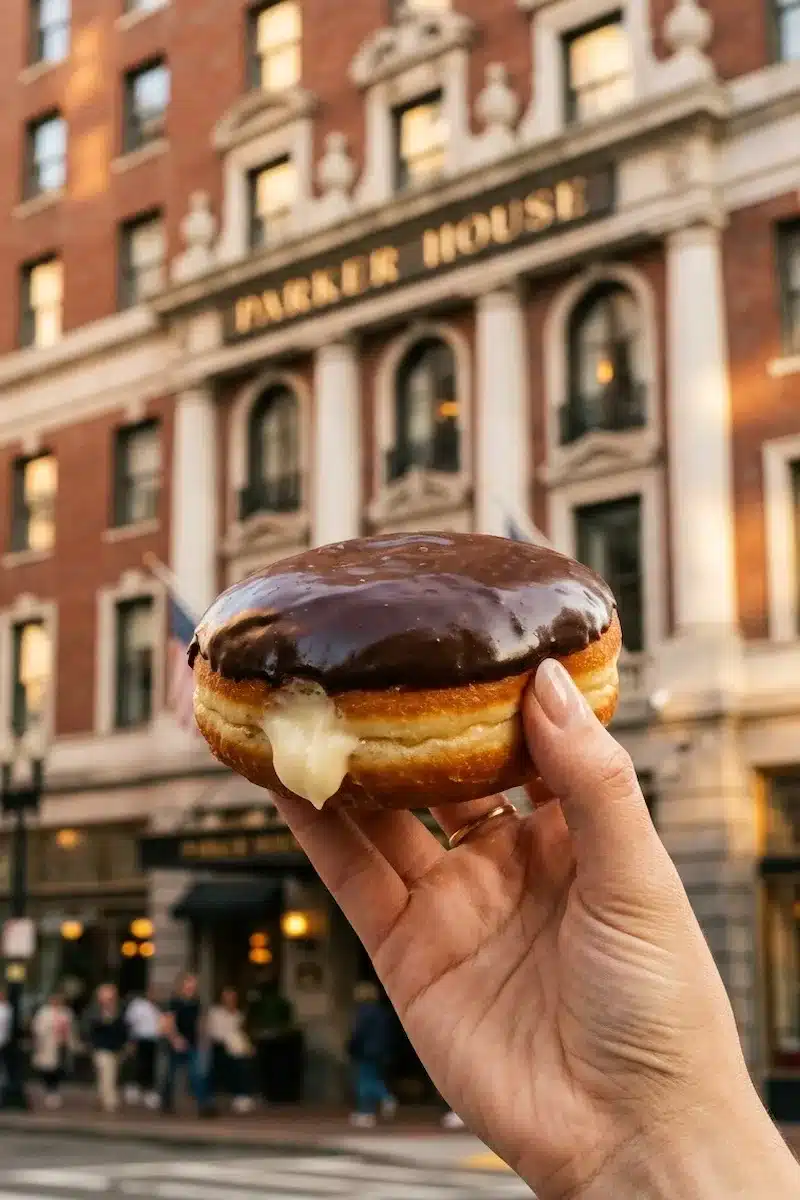
Quick Answer: The Perfect Boston Cream Donut
What you’ll create: a yeasted dough filled with vanilla pastry cream and finished with a glossy chocolate ganache glaze. Ready in about 45 minutes of active work plus rising time. The exterior is lightly crisp, the inside is pillowy soft, and the center delivers a silky, cool custard contrast against the warm chocolate top. This is the classic New England bakery treat made entirely at home, no special equipment beyond a piping bag required.
Table of Contents
What Is a Boston Cream Donut and Why Is It So Beloved?
The Boston Cream Pie Legacy
The Boston cream donut recipe traces its lineage back to 1856 and the Parker House Hotel in Boston, where pastry chef Monsieur Sanzian is credited with creating the original Boston Cream Pie: a simple sponge cake split and filled with pastry cream, then finished with a chocolate glaze on top rather than frosting on the sides. The dessert was unusual for its time because it deliberately left the sides of the cake bare, a stylistic choice that became its signature.
Over the following century, the same flavor combination, vanilla custard sandwiched against a chocolate finish, migrated from the cake format into other vessels. The custard-filled donut version is the most successful of these adaptations, taking the exact flavor profile of the original 1856 dessert and reimagining it as a portable, individually sized pastry that donut shops across the country now treat as a permanent menu staple.
What Makes a Boston Cream Donut Unique
A few specific characteristics separate the Boston cream donut from every other filled pastry on a donut shop counter. It starts with a yeasted dough rather than a cake donut batter, which gives it the light, pillowy texture that distinguishes a true yeasted donut from its denser cake-donut cousins. The dough is fried first, then injected with vanilla pastry cream after cooling, rather than baked with the filling already inside.
The top is dipped or glazed with a chocolate ganache rather than a simple sugar glaze, creating the dark, glossy cap that makes this donut instantly recognizable. And the eating experience delivers three distinct textures in a single bite: the slight chew of the fried exterior, the airy give of the yeasted crumb, and the cool, silky pastry cream donut filling at the center.
Why Boston Cream Donuts Dominate Donut Shops
The flavor balance is a large part of the appeal: rich, eggy custard against a darker, slightly bitter chocolate glazed donut top creates a contrast that prevents the whole pastry from tasting one-note sweet. There is also a strong nostalgic pull, since this flavor combination has been a fixture of American bakeries for well over a century. And the visual signature, white cream peeking out from an injection point with a dark chocolate dome on top, is instantly identifiable on a shelf full of other donuts, which is part of why it remains one of the best-selling items in nearly every shop that makes one.
The Science Behind the Perfect Boston Cream Donut
Yeasted Dough for Pillowy Texture
The dough for a proper Boston cream donut recipe depends on gluten development from kneading, which creates the elastic network that traps gas during fermentation and gives the finished donut its open, pillowy crumb. Fermentation time matters just as much as kneading: a longer first rise allows the yeast to produce more of the byproducts (organic acids and alcohols) responsible for genuine bread flavor rather than a flat, purely sweet taste. Frying temperature controls oil absorption directly: dough fried at too low a temperature absorbs significantly more oil before the exterior sets, producing a greasy result.
Pastry Cream Chemistry
The custard at the center of every Boston cream donut depends on a precise reaction between egg yolks and cornstarch. The starch granules absorb liquid and swell as the mixture is heated, while the egg yolk proteins provide additional thickening and the rich, custardy flavor that distinguishes true pastry cream from a simple pudding. Milk proteins contribute body and structure to the final set. A real vanilla bean, split and infused into the warm milk before the custard is built, gives a depth of flavor that vanilla extract alone cannot replicate.
Chocolate Glaze Science
The chocolate glaze on top is a simple ganache built from a ratio of chocolate to cream, and that ratio determines whether the finished glaze is pourable and glossy or thick and matte. Getting the chocolate to a workable temperature (tempering, in the loose sense used at home) is what produces the shine that makes a finished chocolate-glazed donut look professionally finished rather than dull. The temperature at which the glaze is applied matters too: too hot and it slides off the donut entirely, too cool and it sets before it can spread evenly.
The Best Boston Cream Donut Recipe (Step-by-Step)
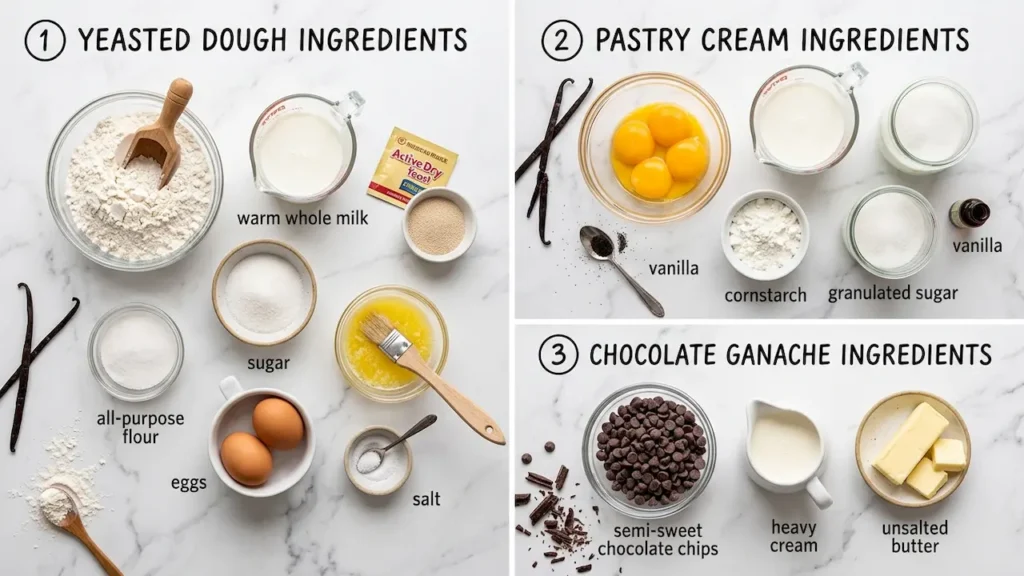
The Ingredient Stack
For the dough: a blend of all-purpose flour and bread flour (the bread flour adds extra gluten strength for a chewier structure), active dry yeast dissolved in warm milk, eggs and butter for richness, and sugar and salt for flavor balance.
For the pastry cream: whole milk and egg yolks form the custard base, cornstarch provides the thickening, and a real vanilla bean (or high-quality vanilla extract) delivers the signature flavor.
For the ganache: semi-sweet chocolate and heavy cream in a ratio that produces a glaze thick enough to coat but thin enough to drip slightly at the edges.
Step-by-Step Preparation
1. Prepare the yeasted dough. Combine the dry and wet ingredients, knead until smooth and elastic, then let rise in a warm spot until doubled. Pro tip: the dough should pass the windowpane test, stretched thin enough to see light through without tearing, before you stop kneading.
2. Make the pastry cream. Whisk egg yolks with sugar and cornstarch, temper with hot vanilla-infused milk, then cook gently while whisking constantly until thickened. Pro tip: strain the finished custard through a fine sieve to catch any small lumps before chilling.
3. Shape the donuts and let them rise again. Divide the dough into equal portions, shape into rounds, and proof a second time until visibly puffed. Pro tip: under-proofed dough at this stage is the single most common cause of dense Boston cream donuts.
4. Fry until golden. Fry in batches at a controlled temperature, turning once, until evenly golden brown on both sides. Pro tip: do not crowd the pot, as overcrowding drops the oil temperature and leads to uneven cooking.
5. Inject the pastry cream. Once fully cooled, use a piping bag fitted with a narrow tip to inject the chilled custard into the center of each donut. Pro tip: insert the tip from the side rather than the top for a cleaner finish with no visible hole.
6. Dip in the chocolate ganache. Dip the top of each filled donut into the warm (not hot) ganache and let the excess drip off. Pro tip: a slight tilt and a gentle twist as you lift the donut away produces the cleanest glaze edge.
7. Let’s set and serve. Allow the ganache to firm at room temperature for 10 to 15 minutes before serving.
Texture Secrets for Bakery-Quality Results
The oil temperature needs to sit at exactly 350 degrees F (175 degrees C): a clip-on thermometer is worth the small investment for this recipe specifically. The dough should be soft and slightly sticky but still workable by hand; too dry and the crumb will be tough. The finished pastry cream should hold a piping consistency, not be runny, which means it needs to be fully chilled (at least 2 hours) before it goes into the piping bag. The ganache should be applied while still warm but no longer hot to the touch, which keeps it fluid enough to dip into without melting the surface of the donut underneath.
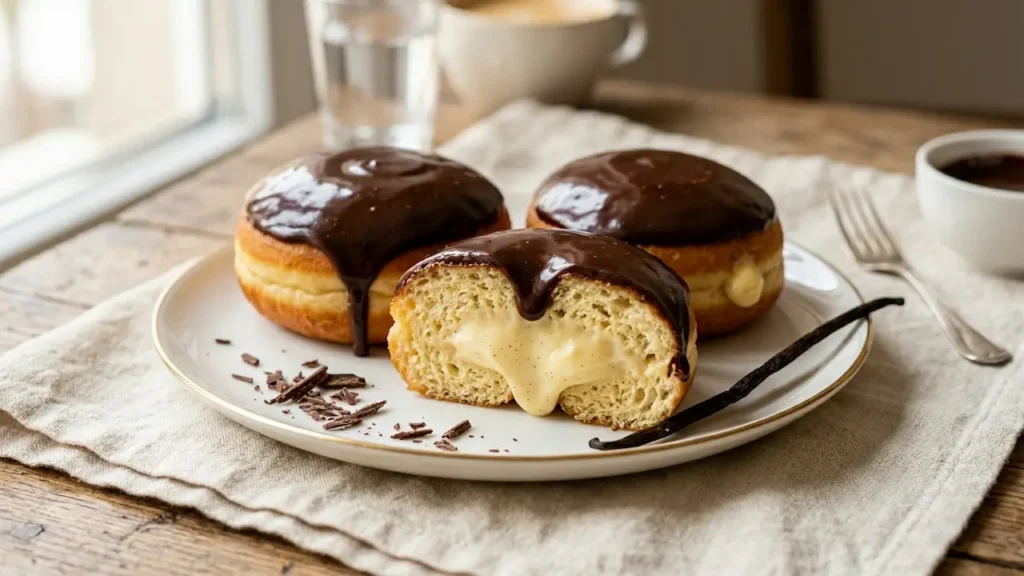
Recipe Card: Boston Cream Donut
| Nutrient | Amount per Donut |
|---|---|
| Calories | approximately 320 to 360 kcal |
| Total Fat | 15 to 18g |
| Carbohydrates | 38 to 42g |
| Sugar | 18 to 22g |
| Protein | 5 to 6g |
Strategic Pairing: Complete Your Boston Cream Donut Experience
Best Beverages to Pair
A classic cup of black coffee is the most traditional pairing for a Boston cream donut recipe, since its bitterness cuts directly through the sweetness of the custard and ganache. Cold milk is the traditional choice for the same reason it pairs well with most custard-filled donut styles: it balances rather than competes. An espresso shot is the most effective option for cutting the richness in a single concentrated sip. Hot chocolate creates a double chocolate experience that some people find excessive and others find exactly right.
When to Enjoy Boston Cream Donuts
This pastry cream donut works equally well as a weekend breakfast indulgence, an afternoon coffee break treat, an after-dinner dessert when something lighter than cake is wanted, or a centerpiece for a special occasion spread alongside other baked goods.
Serving Suggestions
The best texture experience comes from eating a Boston cream donut fresh and still slightly warm, within an hour or two of the ganache’s setting. Room temperature is acceptable and still very good. Refrigeration changes the texture noticeably, firming the custard and dulling the dough’s softness, though it extends shelf life. Freezing is a viable storage option for longer-term keeping.
Boston Cream Donut Variations and Customizations
Classic Boston cream donut. The traditional version: yeasted dough, fried, filled with vanilla pastry cream, topped with a dark chocolate ganache.
Baked Boston cream donut. A healthier adaptation baked in the oven rather than fried, which reduces total fat content while maintaining a very similar flavor profile, though the texture is slightly less rich than the original fried one.
Boston cream donut holes. A bite-sized version using the same components in miniature, easier to produce in volume and well suited to parties or dessert tables where guests want to sample multiple items.
Boston cream donut cake. A layer cake adaptation that returns the format closer to its 1856 origins: round cake layers, a thick pastry cream filling between them, and the same chocolate ganache finish on top.
Vegan Boston cream donut. Built with plant-based milk and butter substitutes, a cornstarch-thickened vegan pastry cream, and a dairy-free chocolate glaze, designed to replicate the same flavor profile without animal products.
Boston cream donut muffins. A muffin-format adaptation that simplifies the home baking process considerably, with the pastry cream baked in as a surprise center rather than injected after the fact.
Frequently Asked Questions About Boston Cream Donut
What Is the Difference Between a Boston Cream Donut and a Boston Cream Pie?
They share the identical flavor profile (vanilla pastry cream and chocolate glaze) but differ entirely in format. The pie uses a sponge cake base split into layers, while the donut uses a fried yeasted dough that is filled after cooking. The donut is the more portable, individually portioned descendant of the original 1856 dessert.
How Long Do Boston Cream Donuts Last?
At room temperature, a filled Boston cream donut is best eaten within the first day, since the custard center is perishable. Refrigerated, it holds well for up to 2 to 3 days. The texture of the dough firms noticeably with refrigeration, so bringing it close to room temperature before eating improves the experience.
Can I Make Boston Cream Donuts Ahead of Time?
The dough and the pastry cream can both be made a day in advance and stored separately in the refrigerator. Frying and assembling (filling and glazing) are best done as close to serving time as possible, since the finished texture degrades faster than either component does on its own.
Why Is My Pastry Cream Runny?
This usually comes down to undercooking, insufficient cornstarch relative to the liquid volume, or skipping the chilling step before piping. The custard needs to reach a full simmer briefly while whisking constantly to fully activate the cornstarch’s thickening power, and it needs a minimum of 2 hours fully chilled before it will hold a piping consistency.
Can I Bake Instead of Fry Boston Cream Donuts?
Yes. A baked version trades some of the richness and slight chew of the fried exterior for a lighter, less greasy result. The flavor profile from the pastry cream and chocolate glaze remains essentially the same regardless of cooking method.
What Is the Best Oil for Frying Donuts?
A neutral oil with a high smoke point, such as vegetable, canola, or peanut oil, is the standard choice. These oils do not impart their own flavor and can hold a stable temperature around 350 degrees F without breaking down.
How Do I Inject Custard Into Donuts Without Making a Mess?
Use a piping bag fitted with a narrow, pointed tip and insert it from the side of the donut rather than the top, which conceals the entry point better. Pipe slowly and stop the moment you feel resistance increase, which signals the donut is full. Wipe the tip clean between donuts to avoid smearing custard on the exterior.
Common Mistakes That Ruin Boston Cream Donuts
Oil temperature is too high or too low. Too high produces a burnt exterior with a raw, doughy center. Too low produces greasy, oil-logged donuts that never develop a proper crust. The target is exactly 350 degrees F, monitored with a thermometer rather than guesswork.
Under-proofing the dough. Skipping or shortening either rise produces dense, heavy donuts instead of the light, pillowy texture that defines a good yeasted donut. Look for visibly puffed, airy dough that springs back slowly when gently poked as your indicator of correct proofing.
Runny pastry cream. Caused by insufficient cooking time, an incorrect ratio of cornstarch to liquid, or skipping the chilling step. The cooling technique matters as much as the cooking technique: chill with plastic wrap pressed directly against the surface of the custard to prevent a skin from forming.
Chocolate glaze is seizing. Caused by even a small amount of water contaminating the chocolate, or by overheating the chocolate past the point where it can recombine smoothly with the cream. Use a gentle, low, and slow heating method and keep every utensil completely dry.
Overfilling the donuts. Too much pastry cream causes it to burst out of the injection point, creating a messy presentation. Pipe slowly and stop as soon as you feel resistance build, rather than filling to a fixed count or volume.
Conclusion: Bringing the Bakery Classic Home
A proper Boston cream donut recipe comes down to four manageable stages: a well-fermented yeasted dough, a properly thickened and chilled pastry cream, a careful fry at the correct temperature, and a glossy chocolate ganache applied at the right moment. None of these steps is difficult on its own. Together, they produce a result indistinguishable from what you would buy at a serious bakery.
For more baking projects that build the same kind of foundational technique, our sourdough cinnamon bread walks through yeasted dough handling in a different format, and our mini pineapple upside-down cheesecake applies a similarly precise approach to custard-based desserts.
Related Reading: Your Baking and Dessert Toolkit
🍩 Keep the Dessert Momentum Going!
Loved this Boston cream donut recipe? Here are 6 more crowd-pleasers from this kitchen:
🎂 Dot Cake Recipe — Fun, playful homemade cake
🌈 Viral Dot Cake — The TikTok sprinkle sensation
🥤 Dot Cake Drink — Drink your dot cake!
🍞 Cottage Cheese Banana Bread — High-protein baking
🧁 Cottage Cheese Banana Muffins — Perfectly portioned
🍫 Chocolate Covered Pecans — Simple chocolate indulgence
Your dessert game is about to level up!
Ready to Make Your Boston Cream Donuts? 🍩✨
This bakery classic is easier than you think! Save the pin for the visual guide, or dive into the full recipe below. Which variation will you try first—classic, baked, or mini donut holes?
💡 Why save? You’ll get a visual ingredient checklist + step-by-step photos!