
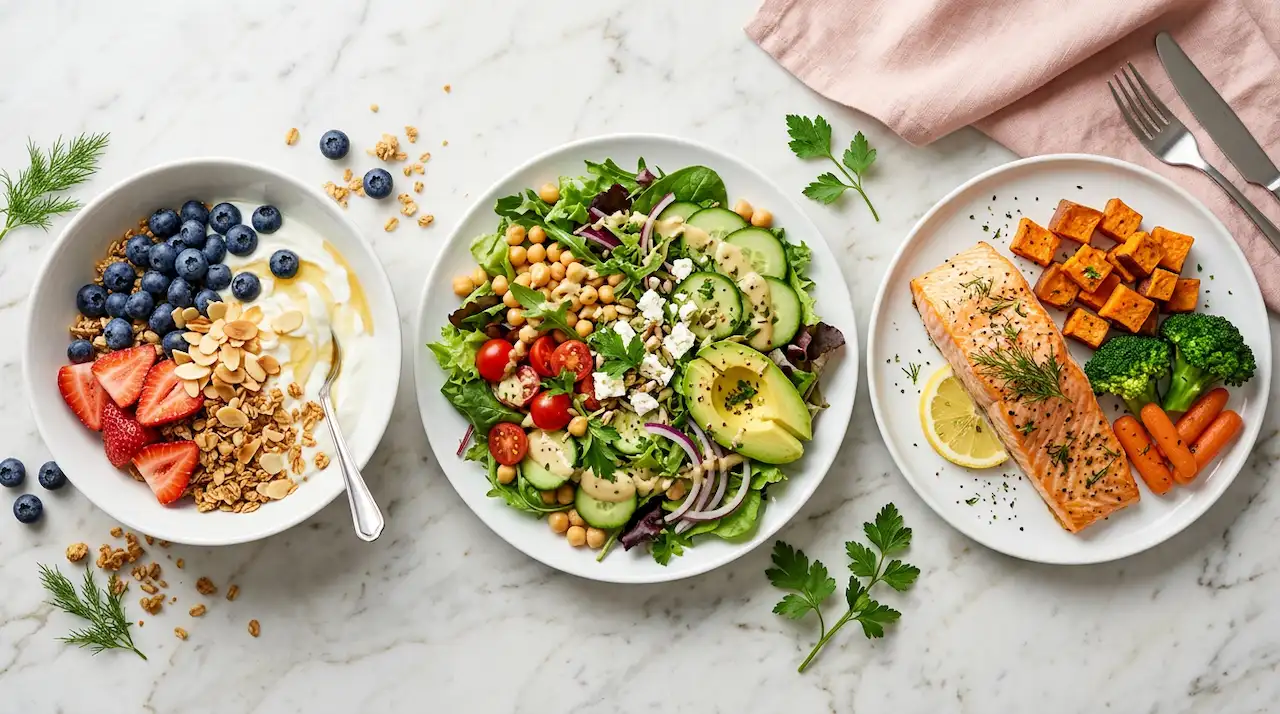
The most important thing about what Eric Topol eats in a day is that it does not involve anything exotic, expensive, or difficult to find. No supplements with six-syllable names. No expensive powders shipped from overseas. No biohacking devices measuring glucose in real time, though Topol has written extensively about continuous glucose monitors as a research tool. Just food, chosen deliberately, timed thoughtfully, and sourced from whole plant and animal ingredients that have decades of rigorous epidemiological evidence behind them.
Dr. Eric Topol is a cardiologist, genomics researcher, and the founder and director of the Scripps Research Translational Institute. He is the author of “The Patient Will See You Now,” “Deep Medicine,” and “Super Agers,” and his Ground Truths Substack (groundtruths.substack.com) has become one of the most trusted sources of evidence synthesis in medicine and longevity research. He does not sell supplements. He does not have a meal delivery program. He publishes what he reads and what he concludes from it, and the nutritional picture that emerges from his public writing is consistent, specific, and actionable.
What follows is a meal framework built from those publicly stated principles: a realistic sample day, three complete recipes that implement the framework in the kitchen, and a three-week implementation plan for building these habits progressively without overhauling your entire kitchen at once.
Table of Contents
The Core Principles Behind the Framework
Before the recipes, the principles. These are the nutritional commitments that appear consistently across Topol’s public writing, interviews, and research recommendations. They are not rules in the sense of a prescribed diet protocol. They are priorities that shape the daily food environment.
Time-restricted eating within a 12-hour window. Topol has discussed the evidence on time-restricted eating (TRE) extensively, noting that compressing daily eating into a consistent 10 to 12-hour window aligns with circadian biology, supports metabolic health markers, and reduces the chronic overnight digestive burden that extended late-night eating creates. This does not mean aggressive fasting; an 8 AM to 8 PM eating window is both reasonable and consistent with the evidence base he cites.
Fiber as a primary daily priority. Topol consistently highlights fiber as one of the most underutilized nutritional tools for longevity. His public writing references the evidence on gut microbiome diversity, short-chain fatty acid production, GLP-1 stimulation, and colorectal cancer risk reduction that emerges from 25 to 35 grams of daily dietary fiber from diverse whole food sources. This is not a supplement recommendation; it means vegetables, legumes, whole grains, fruits, nuts, and seeds as the foundation of every meal.
Zero ultra-processed foods. This is the most categorical position in Topol’s nutritional framework, and it is not nuanced. Ultra-processed foods (UPFs), as defined by the NOVA classification system (industrial formulations with five or more ingredients, including additives, emulsifiers, flavor enhancers, and preservative systems not used in home cooking), are associated in his cited research with significantly elevated risk of cardiovascular disease, cognitive decline, metabolic dysfunction, and early mortality. Eliminating them is, in his framing, the single highest-leverage dietary decision most people can make.
Plant-forward base with strategic protein. Topol’s dietary pattern leans heavily on plants as the primary macronutrient source (vegetables, legumes, whole grains, fruits, and nuts) while including high-quality lean protein from fish (particularly oily fish like salmon and sardines for omega-3 fatty acids), eggs, and occasional lean poultry. Red meat appears infrequently, and processed meat not at all.
Consistency over perfection. Perhaps the most practically important principle is the evidence. Topol’s synthesis consistently shows that long-term dietary pattern adherence matters more than short-term dietary precision. A diet that is 85% aligned with these principles every day for decades produces better health outcomes than a diet that achieves 100% alignment for 30 days and then is abandoned.
These principles align with foundational habits for extending healthspan through consistent, whole-food choices rather than through any single superfood or supplementation protocol.
A Sample Day of Eating: Timeline and Breakdown
This is a representative day built from the principles above. It is not a prescription. It is an illustration of how the principles translate into actual meals at actual times.
8:00 AM: Breakfast, the Longevity Bowl. The eating window opens. The first meal prioritizes fiber, polyphenols, and healthy fat from whole plant sources, with protein from Greek yogurt or eggs depending on preference. The berry and seed combination provides anthocyanin antioxidants, omega-3 fatty acids from chia and flaxseed, and prebiotic fiber from oats. Estimated fiber contribution: 10 to 14 grams.
1:00 PM: Lunch, the Big Green Salad. The largest meal of the day in terms of volume and micronutrient density. A generous base of leafy greens, legumes, raw vegetables, and seeds dressed with olive oil and lemon. The goal is maximum dietary diversity in a single bowl: Topol has referenced the evidence that eating 30 or more distinct plant varieties per week is associated with significantly greater gut microbiome diversity and health outcomes. A well-constructed salad can contribute 8 to 12 of those 30 varieties in one sitting. Estimated fiber contribution: 12 to 16 grams.
4:00 PM: Snack, the Longevity Nut Mix. A small portion of mixed raw or dry-roasted nuts (walnuts, almonds, Brazil nuts, and pistachios) with no added salt, sugar, or oil. This is the meal most easily skipped on days when the lunch was large and satisfying, and that is fine. Its purpose is to bridge the afternoon energy window without reaching for ultra-processed snacks. Estimated fiber contribution: 3 to 4 grams.
7:00 PM: Dinner, light and early. The final meal of the day closes before 8 PM to respect the 12-hour eating window. It is intentionally lighter than lunch: a portion of baked salmon or another oily fish with roasted vegetables. No heavy starch late in the evening. Estimated fiber contribution: 6 to 8 grams.
Daily totals: Dietary fiber approximately 31 to 42 grams. Eating window 11 to 12 hours. Ultra-processed food count: zero.
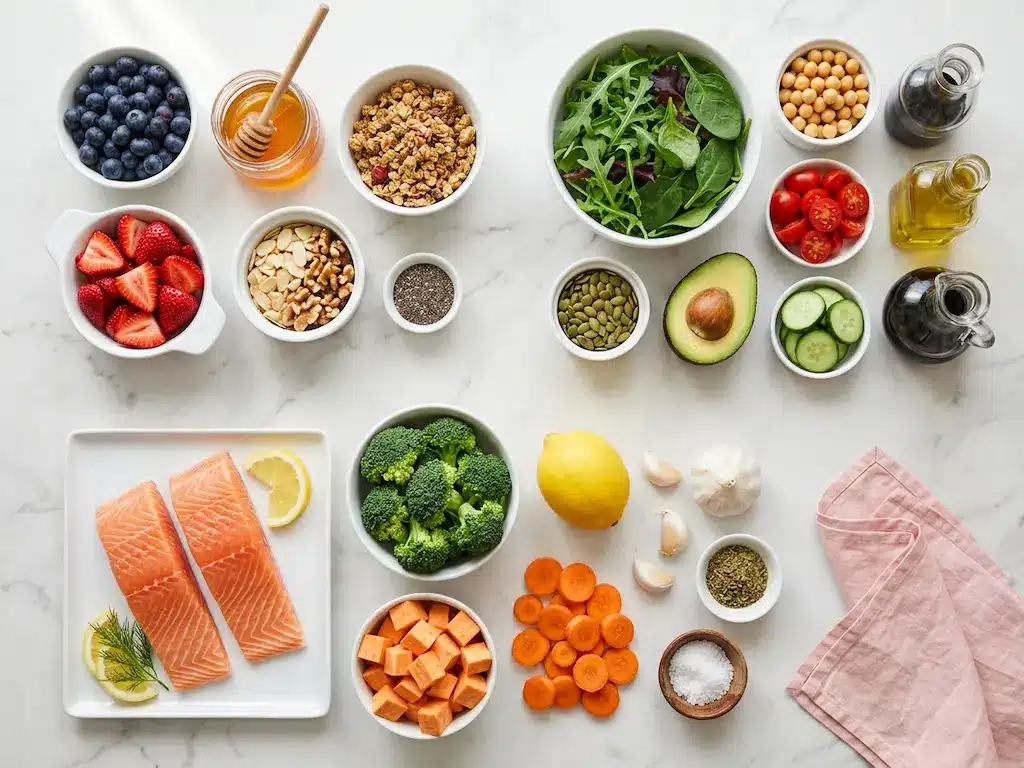
Recipe 1: Longevity Berry and Seed Breakfast Bowl
This bowl is built around four nutritional priorities from Topol’s framework: diverse fiber sources, polyphenol-rich berries, omega-3 fatty acids from ground seeds, and protein sufficient for sustained morning satiety without heaviness.
Prep time: 5 minutes | Cook time: 5 minutes (if using warm oats) or zero (overnight) | Servings: 1
Ingredients:
- Half cup rolled oats (old-fashioned, not instant)
- 1 cup unsweetened plant milk or water
- Half cup mixed fresh or frozen berries (blueberries, raspberries, blackberries)
- 1 tablespoon ground flaxseed
- 1 tablespoon chia seeds
- 1 tablespoon crushed walnuts
- 1 teaspoon raw honey or a few drops of liquid stevia
- Half teaspoon ground cinnamon
- Optional: 2 tablespoons of plain whole-milk Greek yogurt or skyr on the side for additional protein
Instructions:
Warm oats version: Combine oats and milk in a small saucepan over medium heat. Cook for 4 to 5 minutes, stirring occasionally, until the oats have absorbed most of the liquid and reached a creamy consistency. Transfer to a bowl. Top with berries, ground flaxseed, chia seeds, and walnuts. Drizzle lightly with honey if using. Finish with cinnamon.
Overnight version: Combine oats, milk, chia seeds, and flaxseed in a jar or container the night before. Stir well, cover, and refrigerate overnight. In the morning, top with berries, walnuts, and cinnamon. No cooking required.
Nutrition snapshot (approximate, warm version without yogurt):
- Calories: 380 to 420 kcal
- Fiber: 11 to 14 grams
- Protein: 10 to 12 grams
- Omega-3 fatty acids: approximately 3.5 grams (from flax and chia)
- Distinct plant varieties: 6 to 8 (oats, berries, flax, chia, walnut, cinnamon)
Boost this bowl with fiber-rich seeds like chia for added omega-3s and sustained morning energy that carries through to lunch without a mid-morning crash.
PrintLongevity Berry and Seed Breakfast Bowl
A fiber-rich breakfast bowl packed with berries, chia seeds, flaxseed, oats, and walnuts for sustained energy and longevity-focused nutrition.
- Prep Time: 5 minutes
- Cook Time: 5 minutes
- Total Time: 10 minutes
- Yield: 1 bowl 1x
- Category: Breakfast
- Method: Stovetop
- Cuisine: Healthy
- Diet: Vegetarian
Ingredients
- 1/2 cup rolled oats
- 1 cup unsweetened plant milk
- 1/2 cup mixed berries
- 1 tablespoon ground flaxseed
- 1 tablespoon chia seeds
- 1 tablespoon crushed walnuts
- 1 teaspoon raw honey
- 1/2 teaspoon cinnamon
- 2 tablespoons Greek yogurt (optional)
Instructions
- Add oats and plant milk to a saucepan.
- Cook over medium heat for 4 to 5 minutes until creamy.
- Transfer oats to a serving bowl.
- Top with berries, chia seeds, flaxseed, and walnuts.
- Drizzle with honey.
- Finish with cinnamon.
- Add Greek yogurt if desired.
- Serve immediately.
Notes
Use frozen berries for convenience and extra antioxidants. Ground flaxseed improves omega-3 absorption.
Recipe 2: Big Green Longevity Salad
This is the nutritional centerpiece of the day: a large, diverse, deeply satisfying salad designed to deliver maximum plant variety, dietary fiber, and micronutrient density in a single bowl. The goal is not a side salad. It is a full meal in a bowl.
Prep time: 15 minutes | Cook time: 0 (or 20 minutes if adding roasted chickpeas) | Servings: 1 large or 2 medium
Ingredients for the salad base:
- 2 large handfuls of mixed leafy greens (arugula, spinach, watercress, or a mix)
- Half cup cooked or canned chickpeas (rinsed and drained)
- Half cup cherry tomatoes, halved
- Quarter cup cucumber, diced
- Quarter cup shredded red cabbage
- 2 tablespoons pumpkin seeds (pepitas)
- 1 tablespoon sunflower seeds
- Quarter of an avocado, sliced
- 2 tablespoons fresh flat-leaf parsley
- Optional: half cup cooked whole grain such as farro, quinoa or barley for additional fiber and satiety
Ingredients for the dressing:
- 2 tablespoons extra-virgin olive oil
- Juice of half a lemon
- 1 teaspoon Dijon mustard
- 1 small garlic clove, minced or grated
- Pinch of flaky sea salt
- Freshly ground black pepper
Instructions:
Combine all salad ingredients in a large bowl. In a small jar or cup, whisk together all dressing ingredients until emulsified. Pour over the salad and toss thoroughly to coat every leaf and ingredient. Serve immediately for the best texture.
If adding roasted chickpeas for additional crunch, pat rinsed and drained chickpeas dry with a kitchen towel. Toss with a small amount of olive oil and smoked paprika. Roast at 425 degrees F (220 degrees C) for 20 to 25 minutes, shaking the pan halfway through, until crisp. Cool for 5 minutes before adding it to the salad.
Nutrition snapshot (approximate, without optional grain):
- Calories: 480 to 540 kcal
- Fiber: 13 to 17 grams
- Protein: 14 to 18 grams
- Healthy fat: 28 to 34 grams (predominantly monounsaturated from olive oil and avocado)
- Distinct plant varieties: 11 to 13
Big Green Longevity Salad
A nutrient-dense longevity salad loaded with leafy greens, chickpeas, seeds, avocado, and olive oil lemon dressing.
- Prep Time: 15 minutes
- Cook Time: 0 minutes
- Total Time: 15 minutes
- Yield: 2 servings 1x
- Category: Lunch
- Method: No-Cook
- Cuisine: Healthy
- Diet: Vegetarian
Ingredients
- 2 handfuls mixed leafy greens
- 1/2 cup chickpeas
- 1/2 cup cherry tomatoes
- 1/4 cup cucumber
- 1/4 cup shredded red cabbage
- 2 tablespoons pumpkin seeds
- 1 tablespoon sunflower seeds
- 1/4 avocado
- 2 tablespoons parsley
- 2 tablespoons olive oil
- Juice of 1/2 lemon
- 1 teaspoon Dijon mustard
- 1 garlic clove
- Salt and pepper
Instructions
- Add leafy greens to a large bowl.
- Add chickpeas, tomatoes, cucumber, cabbage, seeds, avocado, and parsley.
- Whisk olive oil, lemon juice, Dijon mustard, garlic, salt, and pepper together.
- Pour dressing over salad.
- Toss thoroughly until coated.
- Serve immediately.
Notes
Add quinoa or farro for extra fiber and satiety. Fresh herbs boost flavor without processed dressings.
Recipe 3: 15-Minute Baked Salmon and Roasted Vegetables
The evening meal in this framework is light, early, and built around oily fish as the primary protein. Salmon provides approximately 2.5 grams of combined EPA and DHA omega-3 fatty acids per 150-gram serving, the most direct dietary source of the marine omega-3s associated with cardiovascular protection, brain health, and reduced systemic inflammation in Topol’s frequently cited research.
Prep time: 5 minutes | Cook time: 12 to 15 minutes | Servings: 2
Ingredients:
- 2 salmon fillets (approximately 150g each), skin on or off
- 2 cups mixed vegetables for roasting (broccoli florets, halved cherry tomatoes, sliced zucchini, asparagus spears)
- 2 tablespoons extra-virgin olive oil, divided
- 2 garlic cloves, thinly sliced
- Juice of half a lemon
- 1 teaspoon dried oregano or fresh thyme
- Flaky sea salt and freshly ground black pepper
- Optional: capers or a small handful of fresh dill for finishing
Instructions:
Preheat the oven to 425 degrees F (220 degrees C). Line a large rimmed baking sheet with parchment paper. Arrange the vegetables on one half of the baking sheet. Drizzle with 1 tablespoon of olive oil, scatter the sliced garlic over the top, and season with salt and pepper. Toss to coat. Place the salmon fillets on the other half of the baking sheet. Drizzle with the remaining tablespoon of olive oil, squeeze the lemon juice over the fillets, and season with the dried oregano, salt, and black pepper.
Roast for 12 to 15 minutes until the salmon is cooked through with a slight translucency remaining at the very center (which is the optimal texture: fully safe to eat but not dry) and the vegetables are tender and beginning to caramelize at the edges.
Finish with capers or fresh dill if using. Serve immediately.
Nutrition snapshot (approximate, per serving):
- Calories: 420 to 480 kcal
- Fiber: 6 to 8 grams (from vegetables)
- Protein: 36 to 40 grams
- Omega-3 fatty acids: approximately 2.5 grams (EPA and DHA from salmon)
- Distinct plant varieties: 5 to 7
15-Minute Baked Salmon and Roasted Vegetables
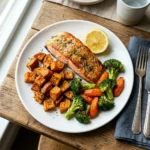
Quick baked salmon with roasted vegetables, olive oil, garlic, and lemon for a simple omega-3 rich dinner inspired by longevity nutrition.
- Prep Time: 5 minutes
- Cook Time: 15 minutes
- Total Time: 20 minutes
- Yield: 2 servings 1x
- Category: Dinner
- Method: Baked
- Cuisine: Healthy
- Diet: Gluten Free
Ingredients
- 2 salmon fillets
- 2 cups mixed vegetables
- 2 tablespoons olive oil
- 2 garlic cloves
- Juice of 1/2 lemon
- 1 teaspoon oregano
- Salt and black pepper
- Fresh dill (optional)
Instructions
- Preheat oven to 425°F.
- Line a baking sheet with parchment paper.
- Add vegetables to one side of the tray.
- Drizzle vegetables with olive oil and season with salt and pepper.
- Place salmon fillets on the other side.
- Top salmon with olive oil, garlic, lemon juice, oregano, salt, and pepper.
- Roast for 12 to 15 minutes.
- Finish with fresh dill if desired.
- Serve immediately.
Notes
Do not overcook the salmon. Slight translucency in the center keeps the fish moist and tender.

How to Implement This Framework: A Three-Week Plan
The most common reason evidence-based dietary frameworks fail in practice is implementation speed. Trying to change everything at once creates decision fatigue, grocery complexity, and the feeling of deprivation that makes any habit unsustainable beyond 10 to 14 days. This three-week plan builds the framework one layer at a time.
| Week | Focus | Key Actions | Troubleshooting |
|---|---|---|---|
| Week 1 | Pantry audit and UPF removal | Read ingredient labels on everything in your pantry. Remove items with more than 5 ingredients or containing additives, emulsifiers and flavor systems. Restock with whole food equivalents: rolled oats instead of instant flavored packets, plain canned legumes instead of flavored beans, olive oil instead of seed oil blends. Do not change what you eat yet: just change what is available. | If the pantry audit feels overwhelming, start with three categories: breakfast cereals, packaged snacks and condiments. These three categories account for the majority of UPF exposure in most Western diets. |
| Week 2 | Fiber habit building | Add one fiber-rich food to each of the three daily meals without removing anything else. Breakfast: the Longevity Bowl as the default morning meal. Lunch: replace whatever you currently eat for lunch with the Big Green Salad at least three days this week. Dinner: add one additional vegetable serving to whatever you are already cooking. Track your approximate daily fiber intake using a food tracking app for the first three to four days to understand your current baseline. | If you experience bloating or digestive discomfort from the fiber increase, slow the ramp-up. Increase by 5 grams per week rather than jumping to the full framework immediately. Adequate water intake (minimum 1.5 to 2 liters daily) is essential when significantly increasing dietary fiber. |
| Week 3 | Eating window adjustment | Establish a consistent eating window between 8 AM and 8 PM. This requires one primary behavioral change: moving the last meal of the day earlier. If you currently eat dinner at 9 or 10 PM, shift it to 7 PM this week. Do not change the meal itself, only the timing. Keep the window consistent including on weekends, which is where most people lose the circadian alignment benefit of TRE. | If late-evening hunger is a significant obstacle, a small portion of the plain warm gelatin drink (without ACV or cranberry) at 7:30 PM provides glycine-mediated satiety and sleep support without meaningfully extending the eating window or adding significant calories. |
FAQs: What Eric Topol eats in a day
What foods should Eric Topol avoid?
Dr. Eric Topol, cardiologist, researcher, and author of Super Agers, is one of the most vocal advocates for evidence-based nutrition. Based on his public writing, his diet excludes several clearly defined food categories. Ultra-processed foods are at the top of the list. Topol has written extensively about UPFs as a leading driver of chronic disease, and foods with emulsifiers, artificial sweeteners, or long additive lists are entirely off his plate. Red meat is another long-standing exclusion. Topol has avoided it for approximately 45 years, citing consistent evidence linking it to cardiovascular disease and systemic inflammation. Refined sugar and high-glycemic carbohydrates contribute to blood glucose spikes, insulin resistance, and accelerated biological aging, all of which are priorities in Topol’s research focus. Trans fats, strongly associated with heart disease, round out the list. For more fiber-focused dietary swaps, see our psyllium and soluble fiber guide.
What do longevity experts eat?
While protocols differ, researchers like Eric Topol, Peter Attia, Valter Longo, and David Sinclair share several core dietary habits. A plant-forward diet forms the foundation, with vegetables, legumes, whole grains, nuts, and fruits consistently linked to lower biological age. Lean or plant-based protein from fish, eggs, and fermented dairy supports muscle preservation during aging, which is a top priority among longevity scientists. A 12-hour overnight fasting window aligns eating patterns with circadian rhythms and supports metabolic and hormonal health. And across the board, every major longevity researcher emphasizes minimizing ultra-processed food exposure as a non-negotiable pillar of long-term health. Explore our healthspan fundamentals to build your own sustainable routine.
What do people on Ozempic eat in a day?
Ozempic and other GLP-1 medications are reshaping how millions approach weight loss, but diet still plays a critical role in outcomes. High-protein foods like chicken, fish, Greek yogurt, eggs, and legumes help preserve muscle mass during rapid weight loss. Smaller, more frequent meals are better tolerated because GLP-1 medications slow digestion, and larger portions increase the likelihood of nausea and discomfort. Adequate hydration, at least eight glasses of water daily, supports digestion and reduces the most common side effects of this drug class. A whole-food emphasis minimizes blood sugar swings and maximizes the metabolic benefits of reduced caloric intake. For natural approaches that complement metabolic health goals, see our natural Mounjaro-inspired recipes and protein-rich breakfast ideas.
The Bottom Line
What Eric Topol eats in a day is, at its core, what the best epidemiological evidence on healthy aging has been pointing toward for decades: abundant plants, diverse fiber, quality protein from whole food sources, minimal processing, and a consistent daily rhythm that respects circadian biology. The framework in this guide is not a diet in the restrictive sense. It is a description of what a food environment built for longevity actually looks like on a Tuesday afternoon.
The most important principle is the one Topol returns to most often in his synthesis of the longevity literature: consistency over perfection. A dietary pattern that is 85% aligned with these principles every day for five years produces health outcomes that no 30-day extreme protocol can approximate. The Longevity Bowl most mornings, the Big Green Salad most lunches, fish a few times per week, no ultra-processed food as a default, and an eating window that ends before the evening is far into its second half. That is the whole framework.
Adapt it to your culture, your kitchen, your budget, and your family. The Brazilian version of this framework looks different from the Californian version, which looks different from the Japanese version, and all three can fully implement these principles using local ingredients and local culinary traditions. The principles are universal. The recipes are illustrations.
Pair this framework with collagen-supporting, protein-rich morning routines to further support healthy aging from the inside out, adding the structural amino acids (glycine, proline, and hydroxyproline) that whole-food diets sometimes underdeliver.
Explore more: high-fiber breakfast ideas with chia and seeds and protein-forward morning protocols for additional resources from this framework.