
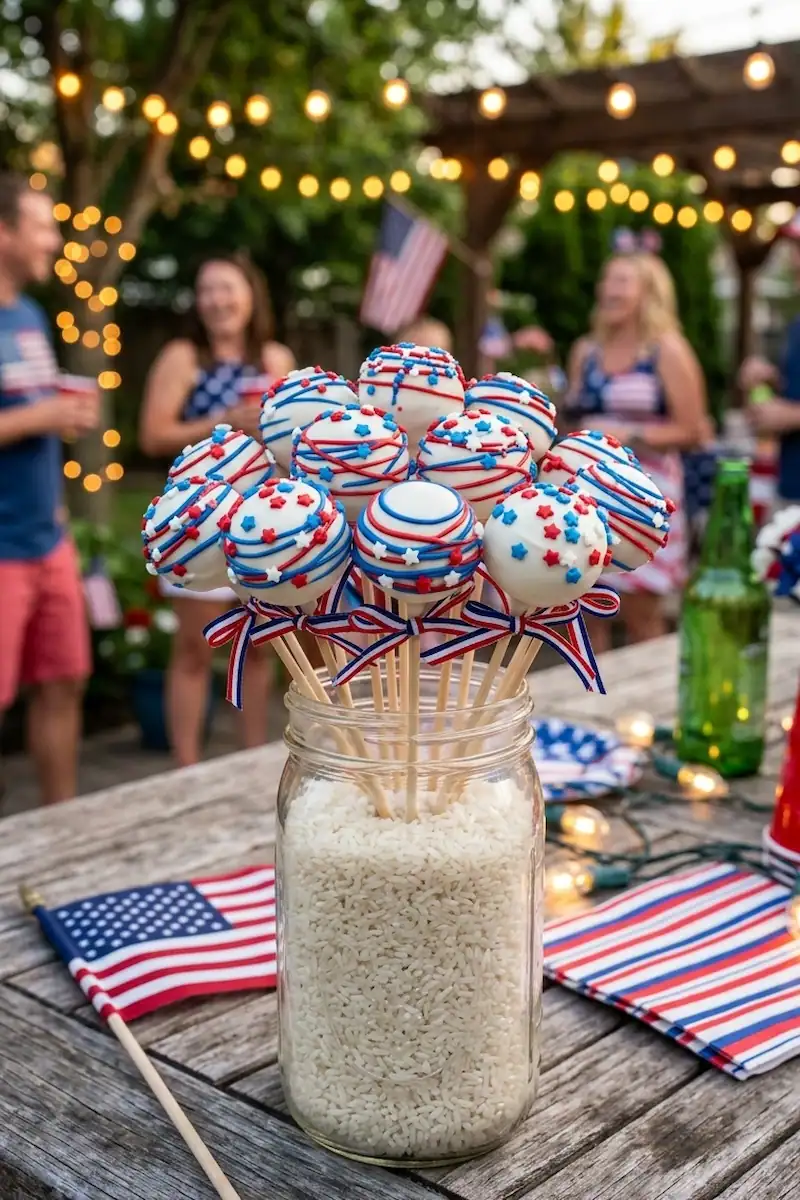
Fourth of July cake pops are the kind of party dessert that disappears from the table before you have finished setting everything else out. They are bite-sized, completely portable, festive without requiring any cake-cutting, and decoratable to whatever level of patriotic enthusiasm suits the occasion. Red, white, and blue candy coating with star sprinkles, striped drizzle patterns, or firecracker-style decoration makes each one a small celebration on a stick.
This guide shows you how to make 4th of July cake pops from scratch: a homemade cake base that is denser and more flavorful than anything from a box, the right frosting-to-crumb ratio for a cake ball that holds together without being gummy, and the specific techniques that prevent the two most common cake pop failures, cracking coatings and pops that fall off the stick mid-dip. Everything is achievable in a home kitchen with standard equipment and a styrofoam block or tall glass for drying.
Table of Contents
What Are 4th of July Cake Pops?
Cake pops are a dessert format invented by baker Angie Dudley (known as Bakerella) in the late 2000s and since popularized by Starbucks and countless home bakers. The core method is simple: bake a cake, crumble it completely, bind the crumbs with frosting until the mixture resembles soft playdough, roll into uniform balls, chill until firm, then dip in a candy coating on a lollipop stick.
For 4th of July cake pops specifically, the decoration does the patriotic work. Red, white, and blue candy melts are the primary tool: each pop can be dipped in a single color and drizzled with the other two, or alternating colors can be used across a batch for a combined display. Patriotic sprinkle mixes (typically a combination of star shapes, red and blue jimmies, and white nonpareils) pressed into the wet coating add texture and visual detail. More elaborate versions use white coating as a base and pipe red and blue stripes to simulate an American flag or use star-shaped candy molds for the coating itself.
The format is particularly well suited to outdoor July 4th gatherings because individual servings on sticks require no plates, no forks, and no slicing. Guests of all ages can pick one up and keep moving, which is exactly the kind of practical consideration that matters at a backyard party.
Ingredients You Will Need
For the cake base:
- 2 and a half cups all-purpose flour
- 1 and a half cups granulated sugar
- 1 tablespoon baking powder
- half a teaspoon fine salt
- half a cup unsalted butter, softened
- 2 large eggs at room temperature
- 1 cup whole milk at room temperature
- 2 teaspoons pure vanilla extract
- optional: red or blue gel food coloring for a patriotic interior surprise
For binding:
- 3 to 5 tablespoons of vanilla buttercream frosting (homemade or store-bought)
- the exact amount varies by cake moisture level: start with 3 tablespoons and add more gradually
For the coating:
- 12 oz red candy melts
- 12 oz white candy melts
- 12 oz blue candy melts
- 1 to 2 teaspoons coconut oil or vegetable shortening per 12 oz bag (to thin the melts for smoother dipping)
For decoration:
- lollipop sticks (6-inch length)
- patriotic sprinkle mix (stars, red and blue jimmies, white nonpareils)
- optional: red and blue gel food coloring for drizzling thinned white coating
Since you prefer homemade dessert bases, our cottage cheese banana bread and our angular banana bread recipe both make excellent, dense, and moist cake pop bases as alternatives to a standard vanilla cake. Their moisture content and crumb density bind particularly well with frosting.
Step-by-Step Instructions
Step 1: Bake and Crumble the Cake
Preheat the oven to 350 degrees F (175 degrees C). Grease and flour a 9-by-13-inch baking pan. Cream the softened butter and sugar together until pale and fluffy, about 3 to 4 minutes with a hand mixer. Add the eggs one at a time, beating well after each addition, then add the vanilla. Alternate adding the flour mixture and the milk in three additions, beginning and ending with flour. Pour into the prepared pan and bake for 28 to 32 minutes until a toothpick comes out clean.
Allow the cake to cool completely in the pan, then on a wire rack. Do not rush this step: warm cake introduced to frosting will cause the fat in the frosting to melt, and the mixture will be too loose to roll into clean balls.
Once fully cool, break the cake into rough pieces and transfer to a large bowl. Use your hands or a stand mixer fitted with the paddle attachment on low speed to crumble the cake into fine, uniform crumbs with no large chunks remaining. The crumbs should be dry enough to fall apart freely when tossed.
Step 2: Mix with Frosting and Roll
Add 3 tablespoons of vanilla buttercream to the cake crumbs and mix with a spatula or your hands until the mixture begins to clump together. The target consistency is playdough: it holds its shape when pressed into a ball but does not feel wet or sticky on your hands. If the mixture crumbles apart when pressed, add frosting one teaspoon at a time until it holds. If it feels sticky, the cake was likely very moist, and no additional frosting is needed.
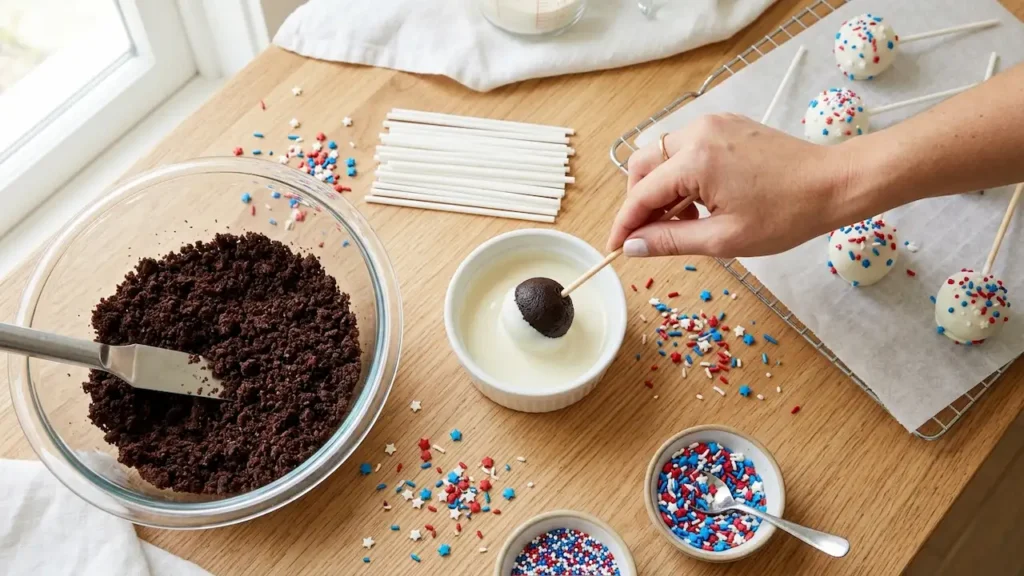
Using a small cookie scoop or a tablespoon as your guide, portion the mixture into equal amounts and roll between your palms into smooth, uniform balls approximately 1 to 1.25 inches in diameter. Uniformity matters here: larger balls are heavier and more likely to fall off the stick during dipping. Place the rolled balls on a parchment-lined baking sheet in a single layer.
Step 3: Chill the Cake Balls
Transfer the baking sheet to the freezer for 15 to 20 minutes, not the refrigerator. The balls need to be genuinely cold all the way through before dipping: cold cake balls create a temperature differential with the warm candy melt that causes the coating to set almost immediately on contact, which is what produces a smooth, even shell. Room-temperature or only slightly chilled balls cause the coating to drip and pool rather than setting cleanly.
Do not leave the balls in the freezer longer than 20 to 25 minutes: balls that are frozen solid rather than simply very cold will cause the coating to crack as they return to room temperature after dipping.
Step 4: Dip in Candy Melts and Decorate
Melt each color of candy melts separately in microwave-safe bowls in 30-second intervals, stirring between each interval, until completely smooth. Add 1 to 2 teaspoons of coconut oil or vegetable shortening to each bowl and stir well: this thins the coating to a consistency that coats the cake ball without building up in a thick, uneven layer.
Work with one color at a time, keeping the others warm over a bowl of hot water or on a heating pad set to low. Remove the chilled cake balls from the freezer in batches of 6 to 8 rather than all at once.
For each cake pop: dip the tip of a lollipop stick about half an inch into the melted candy coating, then immediately insert it about halfway into a cake ball. This coating on the stick acts as adhesive, anchoring the ball in place during the full dip. Allow this initial coating to set for 30 seconds before proceeding.
Hold the stick and submerge the cake ball completely into the melted coating. Lift out and gently tap the stick against the rim of the bowl while slowly rotating it to allow excess coating to drip off evenly. Do not shake or tap aggressively: this dislodges the ball from the stick. Before the coating sets (within 15 to 30 seconds), add your patriotic sprinkles.
Stand the finished cake pops upright in a styrofoam block, a tall glass filled with rice, or a purpose-made cake pop stand while they set. Allow to dry completely, approximately 10 to 15 minutes, before handling or packaging.
Homemade 4th of July Cake Pops Recipe (Red, White, and Blue)
- Yield: 24 cake pops 1x
- Category: Dessert
- Cuisine: American
Ingredients
- 2 1/2 cups all-purpose flour
- 1 1/2 cups granulated sugar
- 1 tablespoon baking powder
- 1/2 teaspoon fine salt
- 1/2 cup unsalted butter, softened
- 2 large eggs at room temperature
- 1 cup whole milk at room temperature
- 2 teaspoons pure vanilla extract
- 3 to 5 tablespoons vanilla buttercream frosting
- 12 oz red candy melts
- 12 oz white candy melts
- 12 oz blue candy melts
- 1 to 2 teaspoons coconut oil per 12 oz bag of candy melts
- lollipop sticks (6-inch length)
- patriotic sprinkle mix
Instructions
- Preheat oven to 350 degrees F. Grease and flour a 9×13 inch baking pan.
- Cream butter and sugar until fluffy. Add eggs one at a time, then vanilla.
- Alternate adding flour mixture and milk in three additions, starting and ending with flour.
- Pour into pan and bake for 28 to 32 minutes until a toothpick comes out clean. Cool completely.
- Crumble the cooled cake into fine, uniform crumbs in a large bowl.
- Add 3 tablespoons of vanilla buttercream to crumbs and mix until it holds together like playdough.
- Roll mixture into uniform balls (1 to 1.25 inches) and place on a parchment-lined sheet.
- Freeze for 15 to 20 minutes.
- Melt candy melts in microwave-safe bowls in 30-second intervals, stirring in between. Add coconut oil to thin.
- Dip the tip of a lollipop stick in candy melt, insert halfway into a cake ball. Let set for 30 seconds.
- Dip the cake ball completely into the melted coating. Tap gently to remove excess.
- Add patriotic sprinkles immediately before the coating sets. Stand upright to dry for 10 to 15 minutes.
Notes
Store finished cake pops in an airtight container at room temperature for up to 2 days, or refrigerate for up to a week.
Nutrition
- Serving Size: 1 cake pop
- Calories: 120
- Sugar: 11g
- Sodium: 45mg
- Fat: 6g
- Saturated Fat: 3g
- Unsaturated Fat: 3g
- Trans Fat: 0g
- Carbohydrates: 16g
- Fiber: 0g
- Protein: 1g
- Cholesterol: 15mg
Decorating Ideas for Independence Day
Single-color dip with drizzle. Dip each pop in white candy melts for a clean base, then drizzle alternating lines of red and blue melts (thinned with a little extra coconut oil for better flow) using a fork or a squeeze bottle. This produces the most recognizable patriotic visual without requiring precision.
Firecracker pops. Dip in red candy melts and immediately press silver or white star-shaped sprinkles and white nonpareils into the wet coating before it sets. The result resembles a burst firework.
Flag stripes. Dip in white and use a thin brush or toothpick to paint alternating red and blue horizontal stripes while the coating is still tacky. Add a small cluster of star sprinkles in the upper left to complete the flag reference.
Alternating color batches. Make a third each in red, white, and blue coatings. Displayed together in a stand, the three colors create the full patriotic color field without any decorating complexity on individual pops.
For more show-stopping party desserts that create visual impact with minimal technique, see our strawberry Dubai chocolate cups for a crack-and-reveal chocolate dessert that works beautifully alongside cake pops on a dessert table and our “What is a Knafeh Chocolate Bar?” guide for another visually striking coated sweet.
PrintFourth of July Cake Pops
- Prep Time: 45 minutes
- Cook Time: 30 minutes
- Total Time: 1 hour 35 minutes
- Yield: 24 cake pops
- Category: Dessert
- Method: Baking
- Cuisine: American
- Diet: Vegetarian
Ingredients
Nutrition
- Serving Size: 1 cake pop
- Calories: 190
- Sugar: 20g
- Sodium: 110mg
- Fat: 8g
- Saturated Fat: 5g
- Unsaturated Fat: 2g
- Trans Fat: 0g
- Carbohydrates: 28g
- Fiber: 0g
- Protein: 2g
- Cholesterol: 25mg
Expert Tips for Perfect Cake Pops
On coating consistency. Candy melts that are too thick produce a heavy, uneven coat that drips and builds up at the base of the ball. Always thin with coconut oil or shortening until the coating flows off the back of a spoon in a slow, steady ribbon. Vegetable oil works in a pinch but produces a slightly less glossy finish.
On cracking coatings. Cracks form when the cake ball and the coating contract at different rates as temperature changes. The most common cause is balls that are frozen solid (too cold) rather than simply very cold. Keep the freezer time at 15 to 20 minutes maximum and work in small batches so the balls do not warm up significantly while waiting.
On pops falling off the stick. Three causes: the ball is too large and heavy, the stick was not pre-dipped in coating before insertion, or the ball was not cold enough to create immediate contact setting of the coating around the stick. Address all three and the problem resolves.
On candy melt temperature. If the melted coating begins to thicken while you work, reheat in 15-second microwave bursts and stir well. Do not allow it to overheat: overheated candy melts seize and become grainy and unworkable.
For a broader grounding in baking precision that applies across cake-based recipes, our guides on why did banana bread collapse and why is banana bread not cooked in the middle cover the oven temperature and fat-to-flour ratio issues that affect most baked cake bases.
More Patriotic Desserts to Serve
A 4th of July dessert table is most satisfying when it offers variety in texture, format, and flavor. These recipes from the site work well alongside the 4th of July cake pops without competing visually or thematically.
Our honey peach cream cheese cupcakes add a seasonal fruit element and a more traditional cupcake format that guests who prefer fork-and-plate desserts will appreciate alongside the handheld cake pops.
Our chocolate mousse gourmet banana provides an elegant, spoonable dessert option for a sit-down portion of the party or for guests who want something lighter and less sweet than the candy-coated pops.
Frequently Asked Questions
How Far in Advance Can I Make 4th of July Cake Pops?
The cake balls (rolled but not yet dipped) can be made up to two days in advance and stored in an airtight container in the refrigerator or up to two weeks in the freezer. Dip and decorate as close to serving time as practical: fully finished cake pops are best within 24 to 48 hours of dipping, as the candy coating can develop a slight bloom (white streaking on the surface) with extended refrigeration.
What Is the Best Homemade Cake Flavor for Cake Pops?
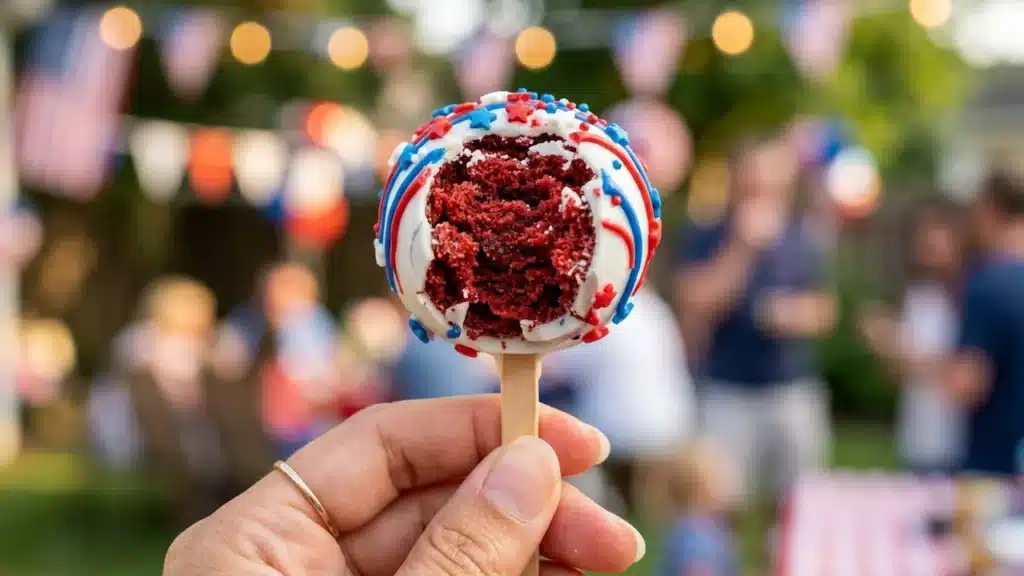
Dense, moist cakes bind better than light, airy sponges because they crumble into finer, more uniform pieces that hold together with less frosting. Vanilla, red velvet, and chocolate are the most reliably successful classic choices. Our sourdough cinnamon bread makes a genuinely excellent and unexpected cake pop base: its slight tang from the sourdough and the warmth of the cinnamon produce a more complex flavor than a standard vanilla cake, and the dense, moist crumb binds beautifully.
Why Did My Cake Pops Fall Off the Stick?
The three most common causes are cake balls that are too large (keep them at 1 to 1.25 inches), sticks that were not pre-dipped in candy melt before insertion into the ball, and balls that were not cold enough to cause the coating to set quickly around the stick. Pre-dipping the stick tip in candy melt and inserting it immediately into a chilled ball, then allowing that initial joint to set for 30 seconds before the full dip, solves the problem in the majority of cases.
Related Reading
Chocolate-Covered Pecans: An easy no-bake addition to your July 4th dessert spread
Dot Cake Recipe: The viral TikTok sprinkle-coated cake trend that shares the same visual appeal as patriotic cake pops
Chewy Dubai Chocolate Cookie: Another crowd-pleasing party sweet that is perfect for celebrations
Ready to Make Your 4th of July Cake Pops? 🎆✨
These patriotic treats are easier than you think! Save the pin for the visual guide, or dive into the full recipe below. Will you try the classic red-white-blue drizzle or the firecracker design first?
📌 Save to Pinterest💡 Why save? You’ll get a step-by-step visual checklist + decorating tips!