
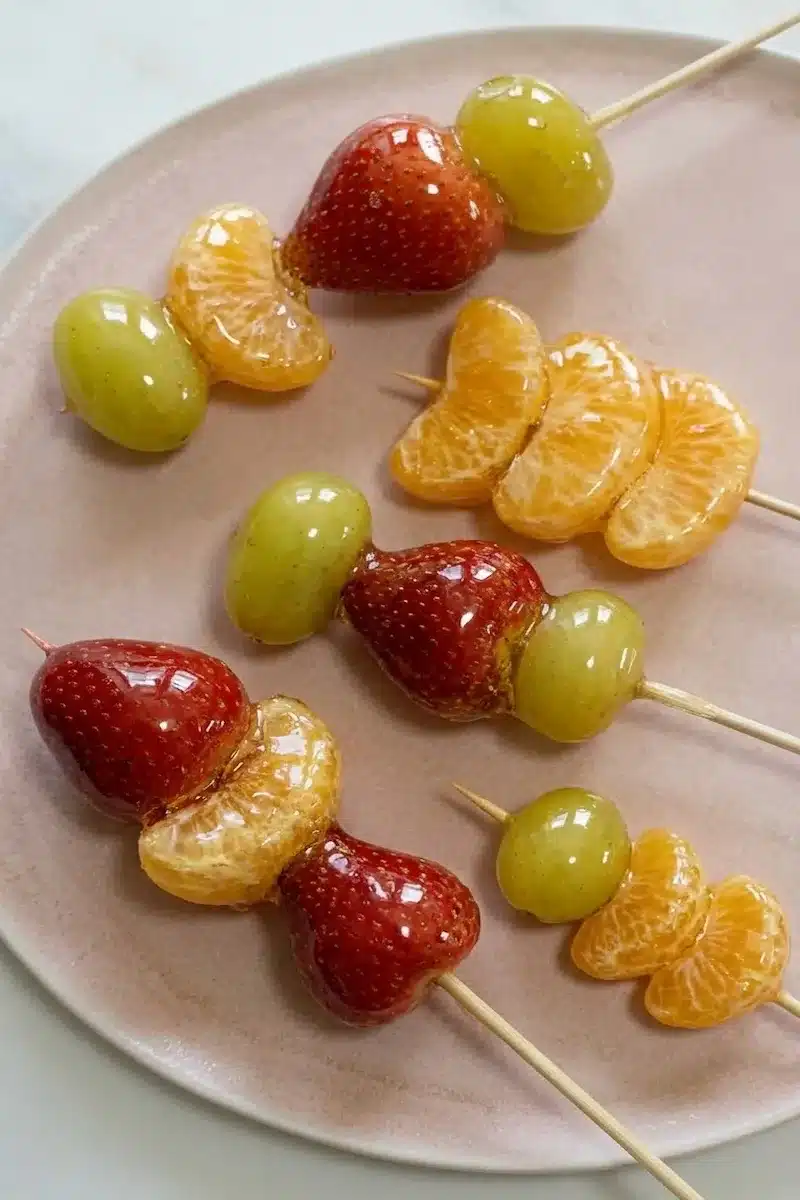
🍓 Quick Answer: The Perfect Tanghulu
What you will create: fresh fruit on bamboo skewers dipped in sugar syrup cooked to the hard crack stage — an ultra-thin, glass-like shell that shatters audibly with every bite. Ready in 20 minutes total. Crystal clear, brilliantly reflective, and deeply satisfying. No wonder tanghulu has hundreds of millions of TikTok views!
Table of Contents
What Is Tanghulu and Why Is Everyone Obsessed?
The Thousand-Year History of Tanghulu
Tanghulu (糖葫芦, pronounced tahng-hoo-loo) has its origins in the Song Dynasty (960 to 1279 CE), where it is said to have been created in Beijing as a remedy for a member of the imperial household who had fallen ill. The original fruit was shan zha, the Chinese hawthorn berry, a small, deep red fruit with a distinctively sour, slightly astringent flavor that the hard sugar shell balanced perfectly. The combination of tart fruit and crackly sweet shell became one of the defining street foods of northern China, and it has remained a fixture of Beijing’s winter markets and street vendor culture continuously since.
The cultural meaning of tanghulu extends beyond simple snacking. The bright red color of the hawthorn berries and the glossy golden-red sugar shell reference traditional Chinese color symbolism associated with happiness, good fortune, and celebration. Vendors selling tanghulu skewers arranged in decorative bundles became a characteristic visual of the Chinese Lunar New Year season in particular.
Over time, the recipe evolved to include whatever fruits were regionally available or seasonally appropriate: strawberries became the dominant choice in the modern era because of their color, size, and firm texture; grapes followed for their visual appeal when coated; and mandarin orange segments and kumquats expanded the citrus territory of the tradition.
The TikTok and Instagram Phenomenon
The reason tanghulu went viral in the West is not complicated: it produces one of the most satisfying sounds in food content. The crack of a glass-thin sugar shell against the surface of a firm, juicy strawberry is ASMR gold, immediate, clean, and physically gratifying in a way that connects with something visceral in the listener. Combined with the visual of a perfectly translucent, reflective sugar coat catching light against the vivid red of the fruit beneath, it creates exactly the kind of content that stops a scroll.
The hashtag dedicated to tanghulu accumulated over 500 million views across platforms, driven by both Chinese creators sharing authentic techniques and Western creators experimenting with different fruits, colors, and presentation styles. The Western adaptations vary widely, with some using flavored syrups, food coloring, or different fruit combinations, while the most technically successful versions consistently return to the same core principle: plain white sugar cooked to the correct temperature, applied to completely dry fruit, and served immediately.
For another viral dessert format that delivers maximum visual impact with minimal technical complexity, see our viral dot cake guide, which covers the sprinkle-coated scoop reveal trend that operates on a similar principle of satisfying visual and audio payoff.
The Science of Crackly Sugar
The glass-like shell of tanghulu is a result of cooking sucrose to the hard-crack stage, between 150 and 155 degrees C (300 to 310 degrees F). At this temperature, almost all the water has been driven out of the syrup, and the sugar molecules exist in what chemists call an amorphous (non-crystalline) state: the molecules are still arranged randomly, as they would be in a liquid, but the viscosity has increased so dramatically that they cannot rearrange themselves into crystals before the coating sets. This is what produces the glass-like clarity and the sharp, shattering crack rather than the chewy, opaque behavior of sugar cooked to a lower temperature.
The enemy of this structure is humidity. Water molecules from the air are absorbed by the amorphous sugar over time, gradually reintroducing enough mobility for the sugar to begin crystallizing or softening. This is why tanghulu must be eaten on the same day it is made and why attempting to make it on a humid day produces a coating that softens within minutes rather than maintaining its crack for hours.
The Best Tanghulu Recipe (Step-by-Step)
The Functional Ingredient Stack
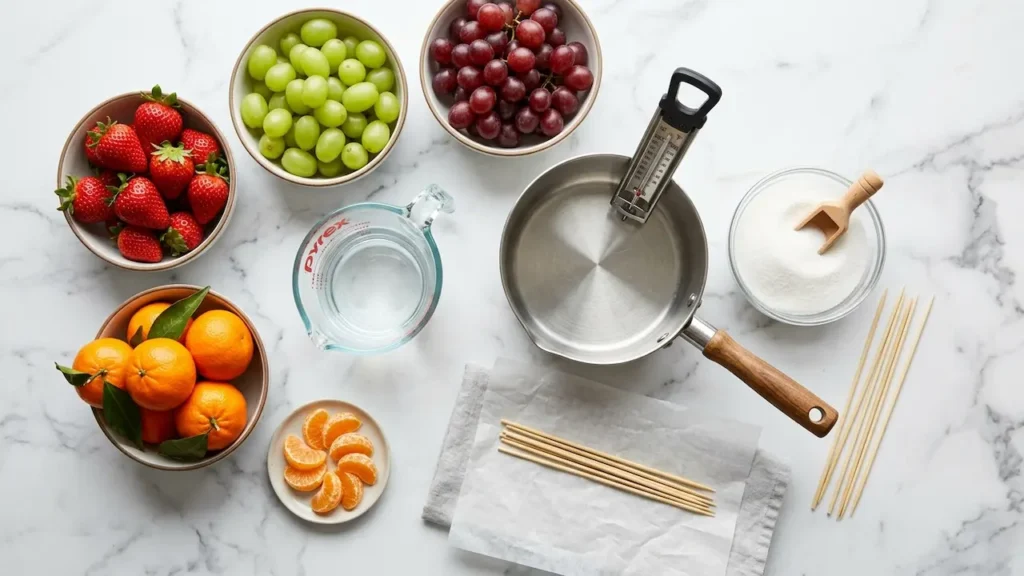
Fresh fruit (choose one or combine):
- strawberries, hulled but whole (the most popular Western choice)
- green or red seedless grapes
- mandarin orange segments or whole peeled kumquats
- pitted cherries
- small, firm whole figs
For the sugar syrup:
- 2 cups (400g) white granulated sugar
- 1 cup (240ml) cold water
This 2:1 ratio (sugar to water by volume) is the standard for tanghulu and should not be altered. Brown sugar, honey, or any colored or flavored sweetener will interfere with the clarity of the final shell and may affect the temperature behavior of the syrup unpredictably.
Essential Equipment
A candy thermometer is not optional for this recipe. The window between a successful tanghulu shell (150 to 155 degrees C) and an undercooked sticky coating (below 145 degrees C) or an overcooked bitter one (above 160 degrees C) is narrow enough that visual cues alone are not reliable for most home cooks. A clip-on digital candy thermometer is inexpensive and makes the difference between consistent results and guesswork.
You will also need bamboo skewers (standard 25cm length, available at any Asian grocery or supermarket baking section), parchment paper for setting the finished skewers, and a cold surface for rapid cooling: a marble slab or a baking sheet chilled in the refrigerator for 20 minutes both work well.
5-Step Preparation
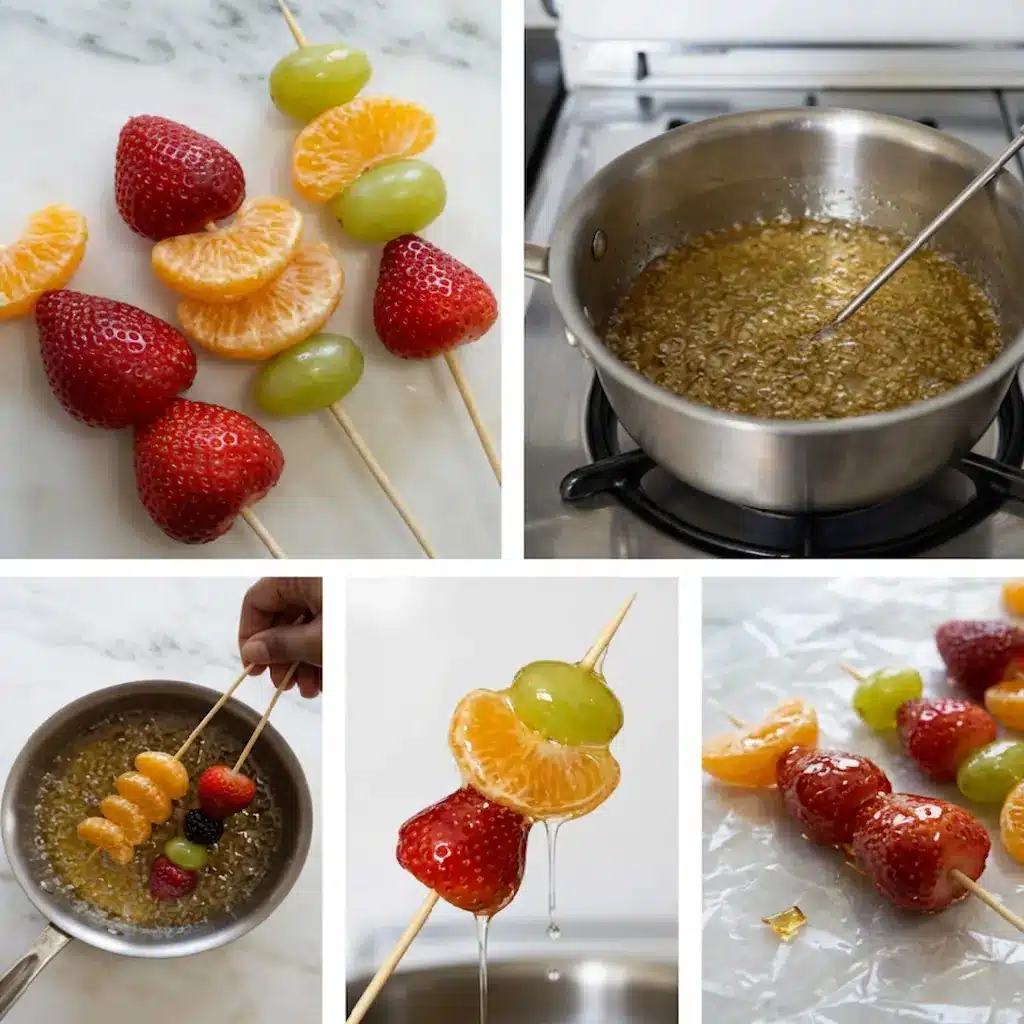
Step 1: Prepare the fruit. Wash all fruit thoroughly and then dry it completely. This step cannot be rushed. Place the washed fruit on layers of paper towel and leave it for a minimum of 30 minutes at room temperature. Any surface moisture, even a film invisible to the eye, will prevent the molten sugar from adhering properly and cause it to slide off the fruit rather than setting in a smooth, even shell. For strawberries specifically, ensure the area around the hull where the stem was removed is also fully dry, as moisture tends to collect there.
Step 2: Thread on skewers. Thread 2 to 3 pieces of fruit per skewer, leaving enough of the skewer handle exposed below the bottom fruit to hold comfortably without touching the sugar. For strawberries, thread through the hull end so the pointed tip faces up. For grapes, thread through the center. Press each piece firmly against the one below it so there are no gaps where sugar could pool and create a thick, uneven joint.
Step 3: Cook the sugar syrup. Combine the sugar and cold water in a medium, heavy-bottomed saucepan. Stir once or twice to wet all the sugar, then place over medium-high heat without stirring again. Stirring a sugar syrup after it comes to heat encourages crystallization. Clip the candy thermometer to the side of the pot so the probe is submerged in the liquid but not touching the bottom of the pan, which would give a falsely high reading.
Cook without stirring, watching the thermometer constantly, until the temperature reaches 148 to 150 degrees C. At this point remove the pan from the heat: the temperature will continue to rise by 2 to 4 degrees from residual heat, reaching the target range of 150 to 155 degrees Celsius.
Step 4: Coat quickly. Working with extreme speed (the syrup will begin to thicken within 60 to 90 seconds of leaving the heat), tilt the pot to one side to create a pool of syrup deep enough to submerge the fruit. Hold a skewer by the handle, submerge the fruit into the syrup with a single smooth motion, and rotate once to coat all surfaces, then lift out and allow the excess to drip for 2 to 3 seconds while continuing to rotate. The entire dipping motion should take about 5 seconds per skewer.
Step 5: Cool and harden. Place each dipped skewer immediately onto the parchment paper or chilled surface. Do not let the skewers touch each other. The sugar shell will harden fully within 60 to 90 seconds at room temperature, or faster on a chilled surface. Once set, the tanghulu is ready to eat: the shell should be completely hard, perfectly transparent, and produce a clean, sharp crack when tapped with a fingernail.
Secrets to Perfect Tanghulu
The drying of the fruit is the step that distinguishes consistently successful tanghulu from occasional successes. Every experienced tanghulu maker, whether a Beijing street vendor or a home cook who has made the recipe twenty times, will confirm that wet fruit is the most common cause of failure. Thirty minutes on paper towels at room temperature is the minimum: if your kitchen is humid, allow longer.
Speed of execution after the syrup reaches temperature is the second critical variable. Have all skewers pre-threaded and laid out in sequence before the syrup goes on the heat. Have the parchment paper ready. Have the cold surface available. When the thermometer hits 148 degrees C, remove from heat and begin coating immediately with no further preparation required.
The dry environment point is worth taking seriously as a planning decision, not just a precaution. If the weather is humid (above 60% relative humidity), the tanghulu shell will soften faster than it would on a dry day. Making tanghulu on very humid days is possible, but the window for eating it while the shell is still perfectly crackly is shorter.
Mastering the Sugar: The Hard Crack Stage
Understanding where the hard crack stage sits within the full progression of sugar cooking helps demystify what is happening in the pot and makes it easier to recognize when the syrup is approaching the target temperature.
| Stage | Temperature | Texture | Use |
|---|---|---|---|
| Thread | 110°C / 230°F | Light syrup, thin threads | Simple syrups, glazes |
| Soft Ball | 120°C / 250°F | Soft, pliable ball in cold water | Fudge, fondant |
| Firm Ball | 130°C / 265°F | Firm but still pliable ball | Soft caramels |
| Hard Ball | 140°C / 285°F | Hard ball, holds shape | Nougat, marshmallow |
| Hard Crack (TARGET) | 150 to 155°C / 300 to 310°F | Glass-like, shatters in cold water | Tanghulu, lollipops, spun sugar |
| Caramel | 160°C+ / 320°F+ | Brown, bitter, amorphous | Caramel sauce, praline |
How to Test Without a Thermometer
The cold water test was the traditional method for identifying sugar stages before thermometers were universally available. Drop a small amount of syrup from a spoon into a cup of ice water and retrieve it immediately. At the hard crack stage it should form a rigid, glass-like thread or shard that snaps cleanly rather than bending. If it bends or feels sticky, the temperature is not yet high enough. If the syrup immediately darkens or smells faintly bitter, it has gone past the target.
That said, buy a thermometer. The cold water test requires practice to interpret reliably, and the narrow temperature window for tanghulu makes it particularly unforgiving of imprecision. A digital candy thermometer is inexpensive and permanently solves the problem.
Temperature Problems and Solutions
If the finished shell is sticky or soft rather than glass-hard, the syrup was not cooked to a high enough temperature. The fix is to return the syrup to the heat and bring it back up to 150 degrees Celsius, watching the thermometer carefully.
If the finished shell tastes slightly bitter or has a brownish tint, the syrup was cooked past 160 degrees C. The sugar has begun caramelizing, which introduces bitter compounds that cannot be reversed. Discard and start again with fresh sugar and water.
The reliable approach is to remove the pan from the heat at 148 to 150 degrees C and allow residual heat to carry it the remaining 2 to 5 degrees rather than trying to remove it at exactly 155 degrees C, which risks overshooting into bitter territory.
Tanghulu Variations: Traditional and Modern
Traditional Chinese Tanghulu
Made with shan zha (Chinese hawthorn berries), this is the version sold from wooden pushcarts in Beijing winter markets. The hawthorn berry has a distinctive sweet-sour flavor, a firm, slightly grainy texture and a small seed at the center that is traditionally left in. Available fresh or preserved in Chinese grocery stores and Asian supermarkets in areas with significant Chinese populations. For anyone who has access to fresh hawthorn, this version gives the most authentic understanding of why tanghulu became a thousand-year tradition.
Strawberry Tanghulu
The most replicated version in Western home kitchens and the one responsible for most of the viral content associated with the trend. Choose firm, bright red strawberries of uniform size for the most visually consistent result. The contrast between the tart strawberry and the pure sugar shell requires no modification: it is the clearest expression of what tanghulu is supposed to taste like in a fruit that is universally available in the West.
Grape Tanghulu
Green seedless grapes produce a particularly striking visual result because the pale green fruit is fully visible through the clear sugar shell, creating a jewel-like appearance that photographs exceptionally well. Red seedless grapes are sweeter and slightly softer, which makes them slightly more challenging to coat evenly but produces a deeper color contrast. Both varieties must be fully dried before dipping: grapes carry a bloom on their surface that holds moisture and requires extra drying time.
Citrus Tanghulu
Whole peeled mandarin segments or small whole kumquats work well for a citrus version. The key with citrus is ensuring the surface is completely free of the white pith membrane, which holds moisture and prevents proper adhesion. Pat each segment dry individually and allow extra drying time. The combination of crystalline sugar sweetness and citrus acid is as effective as the strawberry version and less commonly seen in viral content, which gives it a point of visual distinction.
Rainbow Tanghulu
Alternating different colored fruits on a single skewer, typically strawberry, grape, and mandarin in sequence, maximizes the visual impact for parties and content creation. The technical challenge is ensuring all fruit varieties on the same skewer have similar diameters so the skewer passes through the syrup at a consistent depth during dipping.
Gourmet Tanghulu
Adding a small amount of black sesame seeds, finely crushed pistachios, or finely grated citrus zest to the surface of the sugar immediately after dipping, before it sets, introduces flavor and textural complexity to what is otherwise a pure sugar coating. Press the additions on quickly: the hard-crack sugar hardens within 30 to 60 seconds of leaving the syrup.
Strategic Pairings: Complete Your Tanghulu Experience
Best Beverages to Pair
Hot green tea is the most traditional accompaniment to tanghulu in Chinese food culture: its slight bitterness and vegetal notes provide the exact contrast that the intensely sweet sugar shell benefits from. Jasmine tea offers a more delicate, floral version of the same principle. Sparkling water with lemon serves the same palate-cleansing function in a non-caffeinated, more refreshing format. And bubble tea creates a fun, thematically cohesive pairing for younger audiences or celebrations oriented around Asian food aesthetics.
For another pourable, aesthetic drink that pairs well with tanghulu as a complete dessert experience, see our dot cake drink recipe for a layered, colorful beverage in the same visual register.
When to Serve Tanghulu
Tanghulu works equally well as a children’s afternoon snack (where the crack and the color are the main draws), as a visually striking appetizer at a dinner party where guests are expected to photograph their food, as a light dessert following an Asian-inspired meal, as a Lunar New Year celebration centerpiece, or as individually wrapped edible gifts for special occasions.
Serving Suggestions
The traditional Beijing street presentation uses a bundle of skewers arranged in a cone of colored sugar in a decorative holder, which creates immediate visual drama on a table. For home serving, a glass vase filled with uncooked rice or colored sugar at the bottom to hold the skewers upright is a practical and visually effective alternative. Photography tip: a matte black background makes the reflective sugar shell glow and the fruit colors pop with maximum intensity.
Common Mistakes That Ruin Tanghulu
Wet fruit. The most common failure. Sugar at hard-crack temperature is oleophobic (repels water) and will not bond to a wet surface. It will slide off rather than setting in an even shell. Dry all fruit for a minimum of 30 minutes before beginning any other preparation.
Overcooked syrup. Syrup that passes 160 degrees C develops bitter caramel compounds that cannot be reversed. Remove from heat at 148 degrees C and allow residual heat to finish the job.
Undercooked syrup. Syrup below 145 degrees C will produce a coating that appears to set but softens quickly, sticks to hands and lips, and lacks the satisfying crack that defines the recipe. If in doubt, let it cook longer and trust the thermometer.
Working too slowly after the syrup is ready. Hard crack sugar begins thickening within 60 to 90 seconds of leaving the heat. All fruit must be pre-threaded and within arm’s reach before the syrup begins cooking. Any hesitation during the dipping stage risks working with syrup that is too thick to produce a smooth, even coat.
Making tanghulu on a humid day. This is not a reason to never make tanghulu, but it requires accepting that the window for eating it while the shell is perfectly crackly will be shorter. If possible, run an air conditioner or dehumidifier in the kitchen for 30 minutes before beginning.
Wrong sugar-to-water ratio. The 2:1 ratio is specific and tested. Altering it changes how quickly the syrup reaches the target temperature and how it behaves at that temperature. Use the recipe as written.
Frequently Asked Questions About Tanghulu
How Long Does Tanghulu Last?
Tanghulu is best eaten within 2 to 3 hours of making it. The sugar shell begins absorbing ambient moisture immediately after setting and will progressively soften over several hours. By the following day, most tanghulu shells will have lost their crack entirely. This is not a make-ahead recipe.
Can I Make Tanghulu Without a Thermometer?
Technically yes, using the cold water test described above. Practically, it significantly increases the risk of undercooking or overcooking the syrup, particularly for first-time makers. The investment in a candy thermometer is strongly recommended and makes every subsequent attempt dramatically more reliable.
Why Does My Sugar Crystallize?
Crystallization in a sugar syrup cooking process is caused by agitation, by impurities in the pan (particularly sugar crystals remaining from a previous batch), or by stirring the syrup after it has come to heat. Use a clean pan, do not stir after the initial mixing, and consider adding a small pinch of cream of tartar (less than an eighth of a teaspoon) to interfere with crystallization if it is a recurring problem.
Is Tanghulu vegan?
Yes. The recipe contains only white granulated sugar and water, with fruit as the base. All components are plant-derived with no animal products involved.
Can I Reuse Hardened Sugar?
Yes, with some considerations. If the syrup hardened in the pot before you finished all your skewers, you can reheat it gently over low heat until it liquefies again, then bring it back to temperature. However, the syrup will be more prone to crystallization on the second heating, and the color may be slightly more yellow than the first batch.
What Is the Difference Between Tanghulu and Candy Apples?
Both are fruits coated in hard sugar, but several specific differences distinguish them. Candy apples typically use a corn syrup-based syrup that produces a chewier, less brittle shell. Tanghulu uses pure sugar cooked to the hard crack stage, which produces a thinner, more glass-like shell that shatters rather than bending. The fruit in tanghulu is always served whole or in its natural shape on a skewer; candy apples are almost always served on a stick pushed through the core. And tanghulu has a more delicate, less cloying sweetness because the shell is thinner.
Can I Make Tanghulu Ahead of Time?
No, not in any meaningful sense. The shell softens within hours due to moisture absorption. The practical limit is making it no more than 1 to 2 hours before serving and storing it in a cool, dry environment (not the refrigerator, where condensation will soften the shell almost immediately).
Conclusion: Bring Beijing Street Food Home
The tanghulu recipe has one genuine technical challenge: cooking sugar to exactly the right temperature. Everything else in the recipe is preparation and speed. Once you own a candy thermometer and have dried your fruit properly, the rest follows directly from following the steps in order without hesitation.
The result is one of the most visually striking, texturally satisfying things you can make in a home kitchen in 20 minutes. A glass-thin shell of pure crystalline sugar wrapped around bright, cold fruit, producing a crack on first bite that is both deeply satisfying to experience and immediately understood by anyone watching.
For a coated fruit dessert that uses a different technique (chocolate rather than sugar) for a similarly dramatic reveal, see our strawberry Dubai chocolate cups. For the full range of viral dessert formats that share tanghulu’s ASMR and visual appeal, explore our dot cake drink recipe and viral dot cake guides.
Ready to Make Your Tanghulu? 🍓✨
This viral Chinese street food is easier than it looks! Save the pin for the visual guide, or dive into the full recipe below. Perfect for parties, snacks, or satisfying that sweet tooth!
💡 Why save? You’ll get a visual ingredient checklist + step-by-step photos!
📚 Your Dessert Toolkit
Loved this tanghulu recipe? Here are more crowd-pleasing desserts from this kitchen that deserve a spot in your rotation.
🎂 Viral Dot Cake
Another TikTok sensation that’s taking over social media. Adorable mini cakes coated in rainbow sprinkles with a playful dotted look that’s as fun to make as it is to eat.
Read the Recipe →🥤 Dot Cake Drink Recipe
The pourable version of the viral dot cake trend! A colorful, layered milk drink that captures all the playful vibes in a sippable, aesthetic format.
Read the Recipe →🍓 Strawberry Dubai Chocolate Cups
Another viral dessert featuring coated fruit. Fresh strawberries nestled in crispy kataifi and rich chocolate — the perfect follow-up to mastering tanghulu’s candy shell technique.
Read the Recipe →🍑 Honey Peach Cream Cheese Cupcakes
A fresh fruit dessert in a completely different format. Soft peach cupcakes with honey cream cheese frosting — a sweet taste of summer that pairs beautifully with tanghulu’s crisp texture.
Read the Recipe →🍫 Chocolate Mousse & Gourmet Banana
An elegant, composed dessert worth adding to any dinner party menu. Silky chocolate mousse paired with caramelized bananas — sophisticated, simple, and unforgettable.
Read the Recipe →🍓 Your dessert game is about to level up!